
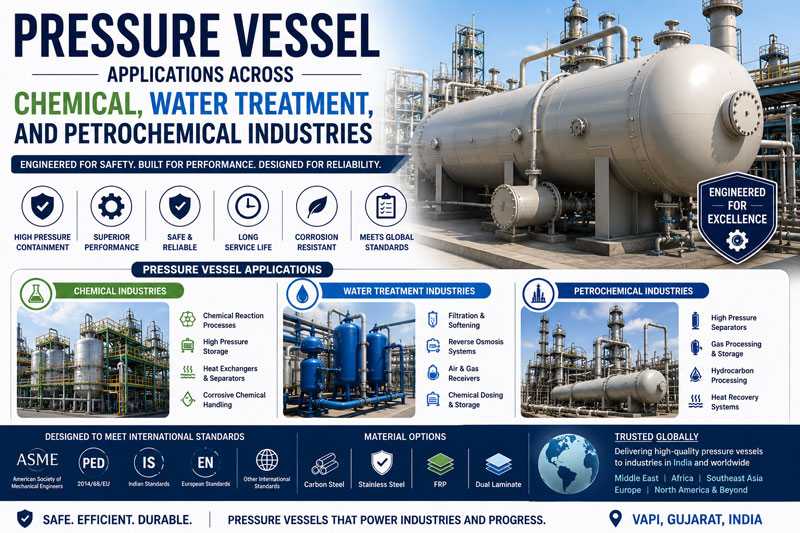
Pressure vessels are among the most important pieces of equipment used in modern industrial operations. From chemical manufacturing and water treatment to pharmaceuticals, petrochemicals, and power generation, pressure vessels are essential for safely storing, processing, and transporting fluids and gases under pressure.
A pressure vessel is a specially designed container engineered to hold liquids, gases, or vapors at pressures significantly different from ambient conditions. These vessels are built to withstand internal or external pressure while ensuring safety, efficiency, and long-term reliability in industrial applications.
As industries continue to expand across India, the Middle East, Africa, Southeast Asia, Europe, and North America, the demand for high-quality pressure vessels has increased significantly, especially in industrial hubs such as Vapi, Gujarat, one of India’s leading chemical manufacturing regions.
Quick Overview of Pressure Vessels
| Feature | Description |
|---|---|
| Primary Function | Store or process fluids under pressure |
| Common Industries | Chemical, Pharmaceutical, Petrochemical, Water Treatment |
| Operating Medium | Liquids, Gases, Vapors |
| Common Materials | Stainless Steel, Carbon Steel, FRP, Dual Laminate |
| Design Standards | ASME, IS, International Standards |
| Applications | Storage, Processing, Heat Transfer, Gas Handling |
| Key Benefits | Safety, Efficiency, Process Reliability |
What Is a Pressure Vessel?
A pressure vessel is a closed container specifically designed to hold substances at a pressure different from the surrounding atmosphere.
These vessels may contain:
- Compressed gases
- Process liquids
- Steam
- Chemicals
- Industrial fluids
- Air and inert gases
Unlike standard storage tanks, pressure vessels are engineered to handle elevated pressures and temperatures safely.
They are used extensively in industrial facilities where process control, fluid containment, and operational safety are critical.
Why Are Pressure Vessels Important?
Many industrial processes rely on pressure to improve efficiency, facilitate chemical reactions, and transport materials.
Pressure vessels help industries:
- Store compressed gases safely
- Maintain process conditions
- Improve production efficiency
- Enable controlled chemical reactions
- Support water treatment operations
- Ensure safe fluid handling
Without properly designed pressure vessels, many industrial processes would be impossible to operate safely and efficiently.
How Does a Pressure Vessel Work?
Pressure vessels are designed to contain fluids or gases while maintaining specific pressure conditions.
The basic operating process includes:
1. Fluid Entry
The process fluid enters the vessel through designated inlet connections.
2. Pressure Containment
The vessel maintains the required internal pressure for storage or processing.
3. Process Operation
Depending on the application, the vessel may:
- Store fluids
- Facilitate chemical reactions
- Separate materials
- Transfer heat
- Filter contaminants
4. Fluid Discharge
The processed material exits through outlet connections for further use.
Safety devices continuously monitor operating conditions to prevent excessive pressure buildup.
Types of Pressure Vessels
Storage Pressure Vessels
These vessels are designed primarily for storing gases or liquids under pressure.
Common applications include:
- Compressed air systems
- Gas storage
- Chemical storage
Process Pressure Vessels
Process vessels are used during manufacturing operations where pressure plays a role in chemical or physical transformations.
Industries include:
- Chemical processing
- Pharmaceutical production
- Petrochemical manufacturing
Heat Exchanger Vessels
These vessels facilitate heat transfer between fluids while maintaining pressure integrity.
Reactor Vessels
Reactor vessels are commonly used in chemical industries where controlled reactions occur under pressure.
Common Shapes of Pressure Vessels
Cylindrical Pressure Vessels
The most widely used design due to its ability to distribute stress evenly.
Spherical Pressure Vessels
Used for high-pressure applications because of their excellent pressure distribution characteristics.
Horizontal Pressure Vessels
Often used when large storage capacities are required.
Vertical Pressure Vessels
Preferred where floor space is limited.
Materials Used in Pressure Vessel Manufacturing
Material selection depends on operating conditions, pressure levels, temperature, and chemical compatibility.
Carbon Steel
Commonly used for general industrial applications.
Advantages include:
- High strength
- Cost effectiveness
- Wide availability
Stainless Steel
Ideal for corrosive environments and hygienic applications.
Industries include:
- Pharmaceuticals
- Food processing
- Chemical manufacturing
FRP Pressure Vessels
Fiberglass Reinforced Plastic pressure vessels provide excellent corrosion resistance and lightweight construction.
Benefits include:
- Corrosion resistance
- Low maintenance
- Long service life
Dual Laminate Pressure Vessels
Dual laminate vessels combine:
- Thermoplastic inner liner
- FRP structural reinforcement
These vessels are highly suitable for aggressive chemical environments.
Industries That Use Pressure Vessels
Chemical Manufacturing
Chemical processing plants rely heavily on pressure vessels for:
- Chemical reactions
- Process storage
- Intermediate processing
Industrial regions such as Vapi, Gujarat utilize pressure vessels extensively due to the concentration of chemical manufacturing facilities.
Water Treatment and Wastewater Treatment
Pressure vessels support:
- Filtration systems
- Chemical dosing operations
- Process water treatment
Pharmaceutical Industry
Pharmaceutical manufacturers require pressure vessels for sterile processing and controlled production environments.
Petrochemical Industry
Petrochemical plants use pressure vessels for:
- Gas storage
- Hydrocarbon processing
- Process control
Power Generation
Power plants utilize pressure vessels in steam systems and various process operations.
Key Design Considerations for Pressure Vessels
Several factors influence pressure vessel design.
Operating Pressure
The vessel must safely withstand the maximum expected pressure.
Operating Temperature
Temperature affects material strength and performance.
Corrosion Resistance
Chemical compatibility is essential for long-term reliability.
Capacity Requirements
The vessel must accommodate process demands efficiently.
Regulatory Compliance
Pressure vessels must comply with applicable industry standards and safety requirements.
Safety Features in Pressure Vessels
Industrial pressure vessels incorporate several safety mechanisms.
Common features include:
- Pressure relief valves
- Safety valves
- Pressure gauges
- Temperature monitoring systems
- Emergency shutdown mechanisms
These systems help prevent overpressure situations and improve workplace safety.
Benefits of High-Quality Pressure Vessels
Improved Process Efficiency
Pressure vessels help maintain stable operating conditions.
Enhanced Safety
Properly designed vessels reduce operational risks.
Longer Equipment Life
Quality materials and engineering improve durability.
Reduced Maintenance Costs
Corrosion-resistant designs minimize maintenance requirements.
Regulatory Compliance
Well-designed systems help industries meet safety and environmental regulations.
Global Demand for Industrial Pressure Vessels
Pressure vessels are widely used across industrial markets including:
- India
- Saudi Arabia
- United Arab Emirates (UAE)
- Oman
- Qatar
- Kuwait
- South Africa
- Kenya
- Nigeria
- Egypt
- Indonesia
- Malaysia
- Vietnam
- United States
- Canada
- Europe
Growing investments in chemical processing, wastewater treatment, and industrial infrastructure continue to drive demand for advanced pressure vessel solutions worldwide.
Frequently Asked Questions
What is the purpose of a pressure vessel?
A pressure vessel safely stores or processes liquids and gases at pressures different from atmospheric conditions.
What industries use pressure vessels?
Chemical manufacturing, pharmaceuticals, petrochemicals, water treatment, wastewater treatment, and power generation industries commonly use pressure vessels.
What materials are used to manufacture pressure vessels?
Carbon steel, stainless steel, FRP, and dual laminate materials are commonly used depending on application requirements.
Are FRP pressure vessels suitable for corrosive chemicals?
Yes. FRP pressure vessels offer excellent corrosion resistance and are widely used in chemical processing applications.
Why are pressure vessels important in chemical plants?
They enable safe storage, controlled reactions, and efficient process operations under pressure.
Conclusion
Pressure vessels are essential components of modern industrial infrastructure. They provide safe containment of fluids and gases under pressure while supporting critical operations across chemical manufacturing, water treatment, wastewater treatment, pharmaceuticals, petrochemicals, and power generation industries.
As industrial development continues in Vapi, Gujarat, across India, and throughout the Middle East and Africa, the demand for reliable, corrosion-resistant, and high-performance pressure vessels will continue to grow.
Nivra Envirotech Pvt. Ltd. specializes in manufacturing advanced pressure vessels, FRP pressure vessels, dual laminate process equipment, chemical storage systems, and industrial environmental solutions designed to meet the demanding requirements of industries across India and global markets.
- chemical industry equipment
- chemical process vessels
- dual laminate vessels
- FRP pressure vessels
- industrial engineering solutions
- industrial equipment
- industrial pressure vessels
- pharmaceutical pressure vessels
- pressure vessel
- pressure vessel applications
- pressure vessel design
- pressure vessel manufacturer
- process equipment
- water treatment pressure vessels
- what is a pressure vessel