
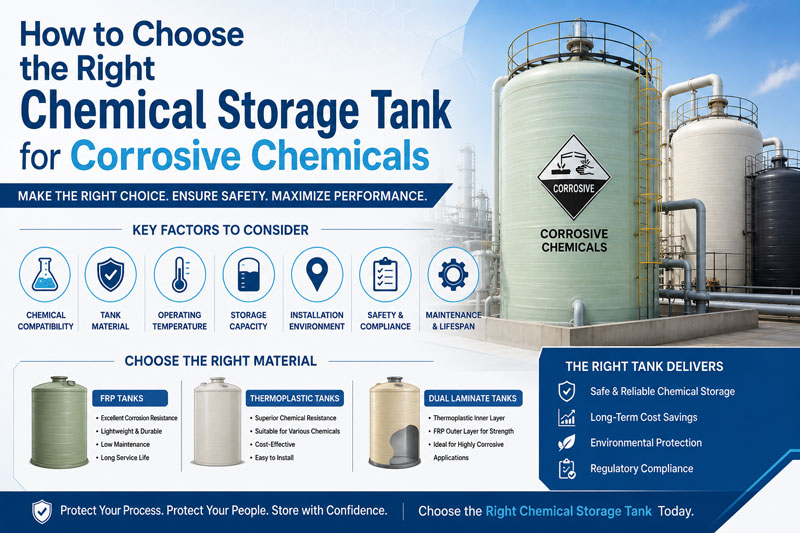
Chemical storage is one of the most critical aspects of industrial operations. Whether you operate a chemical manufacturing plant, wastewater treatment facility, pharmaceutical unit, or metal processing facility, selecting the right chemical storage tank directly impacts safety, operational efficiency, regulatory compliance, and long-term costs.
The best chemical storage tank for corrosive chemicals depends on the chemical being stored, concentration levels, operating temperature, storage capacity, and environmental conditions. Materials such as FRP (Fiberglass Reinforced Plastic), thermoplastics, and dual laminate systems are commonly used because they offer superior corrosion resistance and long service life.
Making the wrong choice can lead to leaks, contamination, equipment failure, environmental damage, and costly downtime. This guide explains the key factors industries should consider when selecting a chemical storage tank for corrosive applications.
Quick Overview
| Factor | Why It Matters |
|---|---|
| Chemical Compatibility | Prevents corrosion and tank failure |
| Tank Material | Determines durability and service life |
| Operating Temperature | Impacts material performance |
| Storage Capacity | Supports production requirements |
| Installation Location | Affects design and protection needs |
| Regulatory Compliance | Ensures safe operation |
| Maintenance Requirements | Influences lifecycle costs |
What Is a Chemical Storage Tank?
A chemical storage tank is a specially engineered vessel designed to safely store corrosive liquids, acids, alkalis, solvents, and process chemicals used in industrial operations.
Unlike conventional storage tanks, chemical tanks must withstand continuous exposure to aggressive substances without degrading, leaking, or compromising safety.
These tanks are commonly used in:
- Chemical manufacturing plants
- Water treatment facilities
- Wastewater treatment plants
- Pharmaceutical industries
- Metal finishing facilities
- Petrochemical operations
- Fertilizer manufacturing units
Why Choosing the Right Tank Matters
Corrosive chemicals can rapidly damage improperly selected storage equipment.
Common consequences of using the wrong tank include:
- Structural failure
- Product contamination
- Environmental hazards
- Workplace safety risks
- Increased maintenance costs
- Production downtime
- Regulatory violations
A properly designed chemical storage tank protects both personnel and assets while ensuring uninterrupted operations.
Step 1: Understand the Chemical Being Stored
The first and most important consideration is the chemical itself.
Questions to ask include:
- Is the chemical acidic or alkaline?
- What is its concentration?
- Does it emit corrosive vapors?
- Is it oxidizing or reactive?
- What is its specific gravity?
- Does it require temperature control?
Even similar chemicals can have significantly different storage requirements depending on concentration and operating conditions.
Common Corrosive Chemicals
| Chemical | Typical Storage Requirements |
|---|---|
| Sulfuric Acid | High corrosion resistance |
| Hydrochloric Acid | Vapor-resistant construction |
| Nitric Acid | Specialized material compatibility |
| Sodium Hydroxide | Alkali-resistant materials |
| Ferric Chloride | Corrosion-resistant systems |
| Caustic Soda | Chemical-resistant tanks |
Step 2: Select the Right Tank Material
The material of construction is one of the most important factors in tank selection.
FRP Chemical Storage Tanks
FRP (Fiberglass Reinforced Plastic) tanks are widely used for corrosive chemical storage due to their excellent chemical resistance and structural strength.
Benefits include:
- Corrosion resistance
- Lightweight construction
- Long service life
- Low maintenance
- High strength-to-weight ratio
Thermoplastic Tanks
Thermoplastic tanks are commonly manufactured using:
- PP (Polypropylene)
- HDPE
- PVC
- PVDF
These materials provide excellent resistance to many acids and alkalis.
Dual Laminate Tanks
Dual laminate tanks combine:
- Thermoplastic inner liner
- FRP structural outer layer
This design offers both superior chemical resistance and structural integrity, making it ideal for highly aggressive environments.
Step 3: Evaluate Temperature Requirements
Temperature significantly affects chemical compatibility and tank performance.
Some chemicals become more aggressive as temperatures increase.
Before selecting a tank, determine:
- Maximum operating temperature
- Ambient temperature conditions
- Potential temperature fluctuations
- Process heating requirements
Choosing a material rated for your operating temperature helps prevent premature failure.
Step 4: Determine Storage Capacity
The required storage volume should align with production and operational needs.
Factors to consider:
- Daily chemical consumption
- Delivery schedules
- Emergency reserve requirements
- Future expansion plans
Oversized tanks may increase costs unnecessarily, while undersized tanks can disrupt operations.
Step 5: Consider Indoor vs Outdoor Installation
Installation location affects tank design requirements.
Outdoor Installations
Outdoor tanks may require:
- UV-resistant construction
- Weather protection
- Wind load considerations
- Temperature management
Indoor Installations
Indoor systems may require:
- Ventilation systems
- Secondary containment
- Space optimization
- Fire safety compliance
Environmental exposure should always be considered during the design phase.
Step 6: Evaluate Corrosion Resistance
Not all tank materials provide the same level of chemical resistance.
A thorough chemical compatibility analysis should be performed before selecting a tank.
Factors influencing corrosion include:
- Chemical concentration
- Exposure duration
- Temperature
- Vapor exposure
- Mixing of chemicals
Investing in a corrosion-resistant system significantly reduces maintenance and replacement costs.
Step 7: Assess Safety Features
Modern chemical storage systems should include essential safety features.
Recommended options include:
- Overflow protection
- Level indicators
- Vent systems
- Leak detection systems
- Secondary containment
- Emergency shut-off arrangements
These features improve workplace safety and help meet regulatory requirements.
Step 8: Ensure Regulatory Compliance
Industries handling hazardous chemicals must comply with applicable environmental and safety regulations.
Key considerations include:
- Chemical handling standards
- Environmental regulations
- Storage guidelines
- Occupational safety requirements
- Industry-specific compliance standards
Selecting a properly engineered tank helps simplify compliance efforts.
Why FRP Tanks Are Popular for Corrosive Chemical Storage
FRP chemical storage tanks have become the preferred choice across many industries due to their combination of strength, durability, and corrosion resistance.
Advantages include:
- Excellent resistance to acids and alkalis
- Long operational lifespan
- Low maintenance costs
- Lightweight construction
- Customizable designs
- Cost-effective lifecycle performance
These benefits make FRP tanks particularly suitable for chemical processing and wastewater treatment facilities.
Industries That Require Corrosion-Resistant Storage Tanks
Chemical Manufacturing
Stores acids, solvents, and specialty chemicals.
Wastewater Treatment Plants
Handles dosing chemicals and treatment agents.
Water Treatment Facilities
Requires safe storage of chlorine, coagulants, and treatment chemicals.
Pharmaceutical Industry
Uses specialized process chemicals and cleaning agents.
Metal Finishing Industry
Stores corrosive chemicals used in plating and surface treatment processes.
Common Mistakes to Avoid When Selecting a Chemical Storage Tank
Many facilities encounter avoidable issues due to improper tank selection.
Common mistakes include:
- Selecting tanks based solely on cost
- Ignoring chemical compatibility
- Underestimating storage requirements
- Overlooking future expansion needs
- Failing to consider temperature effects
- Neglecting safety and compliance requirements
Proper engineering evaluation can prevent these costly errors.
Frequently Asked Questions
What is the best material for storing corrosive chemicals?
FRP, thermoplastics, and dual laminate systems are among the most commonly used materials due to their excellent corrosion resistance.
Are FRP tanks suitable for acid storage?
Yes. Properly engineered FRP tanks are widely used for storing sulfuric acid, hydrochloric acid, and other corrosive chemicals.
How long do chemical storage tanks last?
The lifespan depends on material selection, operating conditions, and maintenance practices. High-quality FRP tanks can provide many years of reliable service.
What factors affect chemical tank selection?
Chemical compatibility, temperature, capacity, installation environment, and regulatory requirements are the primary considerations.
Are dual laminate tanks better than conventional tanks?
For highly aggressive chemicals, dual laminate tanks often provide superior corrosion resistance and structural performance.
Conclusion
Choosing the right chemical storage tank is essential for ensuring safe, efficient, and compliant industrial operations. Factors such as chemical compatibility, tank material, temperature, storage capacity, and environmental conditions must all be carefully evaluated before making a decision.
For industries handling corrosive chemicals, investing in properly engineered FRP, thermoplastic, or dual laminate storage tanks can significantly improve safety, reduce maintenance costs, and extend equipment life.
Nivra Envirotech Pvt. Ltd. manufactures high-performance chemical storage tanks, FRP tanks, thermoplastic tanks, and dual laminate storage solutions designed for demanding chemical, water treatment, and wastewater treatment applications. Our customized systems provide exceptional corrosion resistance, durability, and long-term operational reliability.
- acid storage tanks
- chemical processing equipment
- chemical storage tank
- chemical storage tanks
- chemical tank selection
- corrosion resistant tanks
- corrosive chemical storage
- dual laminate tanks
- FRP chemical tanks
- FRP tank manufacturer
- industrial chemical storage
- industrial storage tanks
- thermoplastic storage tanks
- wastewater treatment tanks
- water treatment chemical storage