
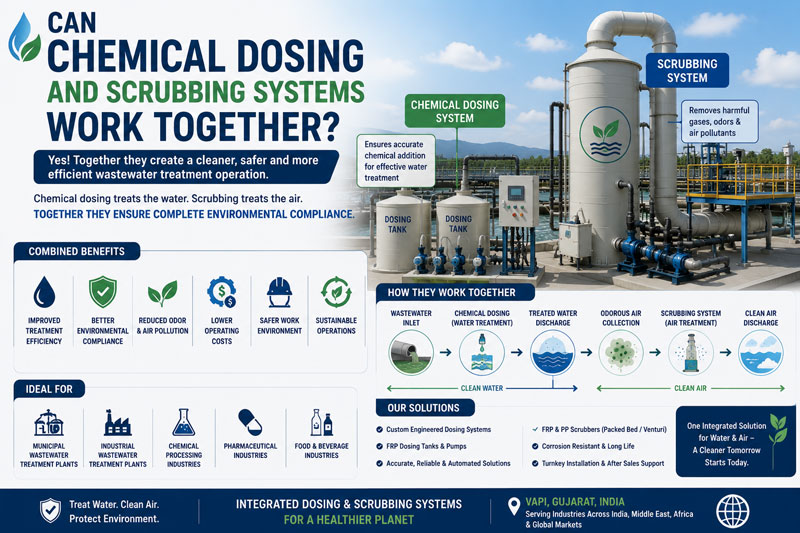
Wastewater treatment facilities face two major challenges: treating contaminated water effectively and controlling harmful gases generated during the treatment process. To achieve regulatory compliance, environmental protection, and operational efficiency, modern treatment plants rely heavily on chemical dosing systems and industrial scrubbing systems.
Chemical dosing systems ensure precise treatment of wastewater by adding the correct amount of chemicals for pH control, coagulation, disinfection, and contaminant removal, while scrubbing systems capture and neutralize toxic gases, odors, and airborne pollutants generated during wastewater treatment operations.
Together, these systems play a critical role in maintaining safe, efficient, and environmentally compliant wastewater treatment facilities.
With growing industrialization in Vapi, Gujarat, India, as well as expanding wastewater treatment infrastructure across Saudi Arabia, UAE, Oman, Qatar, Kuwait, South Africa, Kenya, Nigeria, Egypt, and other global markets, the demand for advanced dosing and scrubbing solutions continues to increase.
Quick Overview
| System | Primary Function |
|---|---|
| Chemical Dosing System | Chemical treatment and process control |
| Dosing Tanks | Safe storage of treatment chemicals |
| Dosing Pumps | Accurate chemical injection |
| Scrubbing System | Toxic gas and odor removal |
| Packed Bed Scrubber | High-efficiency gas treatment |
| FRP Scrubber | Corrosion-resistant air pollution control |
| Combined Benefit | Improved treatment efficiency and compliance |
Why Wastewater Treatment Requires Chemical Dosing and Scrubbing Systems
Wastewater treatment plants handle various contaminants that require both water treatment and air pollution control measures.
Common challenges include:
- High contaminant levels
- pH imbalance
- Suspended solids
- Toxic gases
- Strong odors
- Regulatory compliance requirements
Without proper treatment systems, facilities may face environmental penalties, operational inefficiencies, and safety risks.
Chemical dosing and scrubbing systems work together to address these challenges.
What Is Chemical Dosing in Wastewater Treatment?
Chemical dosing is the controlled addition of treatment chemicals into wastewater streams to achieve specific treatment objectives.
The effectiveness of wastewater treatment often depends on maintaining accurate chemical dosing rates.
Common Chemical Dosing Applications
pH Adjustment
Acids and alkalis are added to maintain optimal pH levels for treatment processes.
Coagulation and Flocculation
Chemicals help suspended particles combine into larger flocs for easier removal.
Disinfection
Chlorine and other disinfectants eliminate harmful microorganisms.
Nutrient Removal
Specialized chemicals help remove nitrogen and phosphorus from wastewater.
Odor Control
Chemical dosing helps reduce odor-causing compounds during treatment.
Why Accurate Chemical Dosing Matters
Even small dosing inaccuracies can significantly affect treatment performance.
Benefits of Accurate Chemical Dosing
- Improved treatment efficiency
- Reduced chemical consumption
- Lower operating costs
- Better compliance with discharge standards
- Consistent treatment results
- Reduced sludge generation
- Enhanced process control
Modern dosing systems help facilities optimize chemical usage while minimizing waste.
Key Components of a Chemical Dosing System
Dosing Tanks
Dosing tanks safely store treatment chemicals before injection.
Benefits include:
- Safe chemical storage
- Consistent chemical concentration
- Improved dosing reliability
Dosing Pumps
Dosing pumps control the flow rate of chemicals entering the treatment process.
Mixing Systems
Mixers ensure chemicals are evenly distributed before dosing.
Monitoring and Control Systems
Automation improves dosing accuracy and reduces manual intervention.
Common Chemicals Used in Wastewater Treatment
| Chemical | Purpose |
|---|---|
| Sulfuric Acid | pH Adjustment |
| Caustic Soda | Neutralization |
| Ferric Chloride | Coagulation |
| Alum | Suspended Solids Removal |
| Sodium Hypochlorite | Disinfection |
| Polymer Solutions | Flocculation |
Proper chemical storage tanks and dosing systems are essential for safe handling of these chemicals.
What Are Scrubbing Systems in Wastewater Treatment?
While wastewater treatment focuses on water quality, many treatment processes also generate harmful gases and odors.
Industrial scrubbing systems are designed to remove these airborne contaminants before they are released into the atmosphere.
Common pollutants include:
- Hydrogen Sulfide (H₂S)
- Ammonia (NH₃)
- Chlorine Gas
- Volatile Organic Compounds (VOCs)
- Odorous Sulfur Compounds
Scrubbers help facilities maintain air quality and environmental compliance.
How Scrubbing Systems Work
The basic scrubbing process includes:
1. Gas Collection
Contaminated air is captured from treatment tanks, pumping stations, and process areas.
2. Gas-Liquid Contact
The polluted air passes through a scrubbing chamber where it comes into contact with a treatment liquid.
3. Absorption and Neutralization
Toxic gases are absorbed and chemically neutralized.
4. Clean Air Discharge
Treated air is safely released into the atmosphere.
Types of Scrubbers Used in Wastewater Treatment
Packed Bed Scrubbers
Packed bed scrubbers provide high removal efficiency for corrosive gases.
Advantages include:
- Excellent gas absorption
- Low operating costs
- Reliable performance
Wet Scrubbers
Wet scrubbers use water or chemical solutions to remove pollutants.
These systems are highly effective for:
- Odor control
- Acid gas removal
- Toxic gas treatment
FRP Scrubbers
FRP scrubbers are widely used because wastewater treatment environments are highly corrosive.
Benefits include:
- Corrosion resistance
- Lightweight construction
- Long service life
- Low maintenance requirements
Benefits of Combining Chemical Dosing and Scrubbing Systems
Facilities that integrate both technologies achieve superior operational performance.
Improved Environmental Compliance
Both water and air emissions can be controlled effectively.
Enhanced Worker Safety
Reduced exposure to hazardous chemicals and gases.
Better Treatment Performance
Accurate dosing improves water quality while scrubbers improve air quality.
Lower Operating Costs
Efficient systems reduce waste and maintenance requirements.
Sustainable Operations
Combined treatment solutions support environmental sustainability goals.
Industries That Require Dosing and Scrubbing Systems
Industrial Wastewater Treatment Plants
Treat wastewater generated by manufacturing facilities.
Chemical Processing Plants
Require both chemical treatment and gas scrubbing systems.
Pharmaceutical Facilities
Need precise dosing and emission control for regulatory compliance.
Petrochemical Industries
Manage complex wastewater streams and air emissions.
Food and Beverage Processing Plants
Require wastewater treatment and odor control systems.
Why FRP Equipment Is Preferred
Many wastewater treatment chemicals and gases are highly corrosive.
FRP equipment provides several advantages:
- Excellent corrosion resistance
- Long service life
- Lightweight construction
- Reduced maintenance costs
- Reliable performance in aggressive environments
This makes FRP dosing tanks, FRP scrubbers, and FRP process equipment ideal for wastewater treatment applications.
Global Demand for Wastewater Treatment Solutions
The need for advanced wastewater treatment infrastructure continues to grow across:
- Vapi, Gujarat, India
- Saudi Arabia
- United Arab Emirates (UAE)
- Oman
- Qatar
- Kuwait
- South Africa
- Kenya
- Nigeria
- Egypt
- Indonesia
- Malaysia
- Vietnam
Industrial growth and stricter environmental regulations are driving investments in modern treatment technologies worldwide.
Frequently Asked Questions
What is chemical dosing in wastewater treatment?
Chemical dosing is the controlled addition of treatment chemicals to improve wastewater quality and process performance.
Why are dosing tanks important?
Dosing tanks provide safe storage and consistent delivery of treatment chemicals.
What gases do wastewater scrubbers remove?
Scrubbers commonly remove hydrogen sulfide, ammonia, chlorine, VOCs, and odor-causing compounds.
Why are FRP scrubbers preferred?
FRP scrubbers offer excellent corrosion resistance and long-term reliability in harsh wastewater environments.
Can chemical dosing and scrubbing systems work together?
Yes. Combining both systems improves treatment efficiency, air quality, safety, and environmental compliance.
Conclusion
Chemical dosing systems and scrubbing systems are essential components of modern wastewater treatment operations. While dosing systems ensure effective water treatment through precise chemical control, scrubbers protect workers and the environment by removing harmful gases and odors.
As wastewater treatment requirements continue to evolve across India, the Middle East, Africa, and global industrial markets, investing in high-quality dosing tanks, chemical dosing systems, packed bed scrubbers, FRP scrubbers, and air pollution control solutions is critical for long-term operational success.
Nivra Envirotech Pvt. Ltd. specializes in manufacturing advanced chemical dosing systems, dosing tanks, packed bed scrubbers, FRP scrubbers, chemical storage tanks, and wastewater treatment equipment engineered for demanding industrial applications across India and international markets.
- air pollution control equipment
- chemical dosing and scrubbing systems
- chemical dosing systems
- chemical storage tanks
- dosing tanks
- emission control systems
- FRP process equipment
- FRP scrubbers
- industrial scrubbers
- industrial wastewater treatment
- odor control systems
- packed bed scrubbers
- wastewater treatment equipment
- wastewater treatment systems
- water treatment solutions