
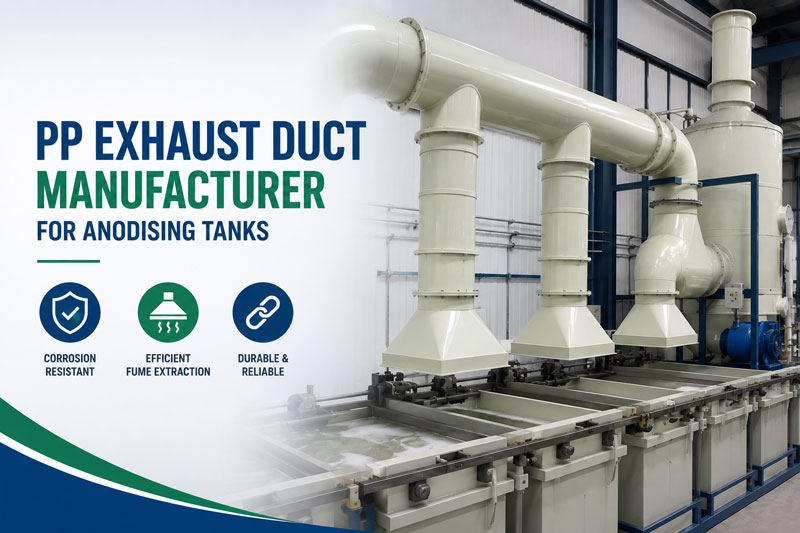
Anodising is a widely used surface treatment process for aluminium and other metals. The process involves chemical baths, acids, alkalis, rinsing, sealing, and other treatments that can generate fumes, vapours, and chemical mist. Without proper source extraction, these emissions can spread into the workplace and affect air quality, equipment, and working conditions.
A properly designed PP Exhaust Duct for Anodising Tanks provides an effective way to capture and transport these fumes from the anodising process to a suitable treatment or exhaust system.
Nivra Envirotech Pvt. Ltd. manufactures customized PP Exhaust Ducting Systems for anodising plants, chemical processing facilities, electroplating units, and other industrial applications where corrosion-resistant fume extraction is required.
What Is a PP Exhaust Duct for Anodising Tanks?
A PP Exhaust Duct is a ducting system manufactured from Polypropylene (PP) and used to convey contaminated air, chemical fumes, vapours, and mist from an industrial process to an exhaust treatment system.
In an anodising plant, PP ducting is generally connected to extraction hoods or tank-side suction points installed around the chemical treatment tanks.
The extracted fumes can then be transported through the duct network to equipment such as:
- FRP Wet Scrubbers
- Packed Bed Scrubbers
- Chemical Gas Scrubbers
- Industrial Exhaust Blowers
- Exhaust Stacks
This creates a complete Industrial Fume Extraction System for the anodising process.
Why Is PP Used for Anodising Tank Exhaust Ducting?
Anodising processes can involve aggressive chemicals and corrosive fumes. Therefore, the material used for exhaust ducting needs to withstand the operating environment.
PP is widely considered for chemical exhaust applications because it offers:
- Good chemical resistance
- Corrosion resistance
- Lightweight construction
- Easy fabrication and welding
- Low maintenance requirements
- Smooth internal surfaces
- Long service life when properly designed
- Suitability for many chemical fume applications
The exact material selection should always be based on the chemicals involved, concentration, temperature, airflow, and operating conditions.
How Does an Anodising Tank Fume Extraction System Work?
A typical system works through a series of connected components:
Anodising Tank → Extraction Hood → PP Exhaust Duct → Industrial Blower → Scrubber → Exhaust Stack
1. Fume Generation
During anodising and chemical treatment, fumes, vapours, or mist may be generated from the process tanks.
2. Source Capture
An extraction hood or suitable capture arrangement collects the contaminants close to their source.
3. Fume Transportation
The contaminated air travels through the PP Exhaust Ducting System.
4. Air Movement
An appropriately selected industrial exhaust blower maintains the required airflow throughout the system.
5. Fume Treatment
Depending on the pollutants, the exhaust air can be directed to an FRP wet scrubber or other suitable treatment equipment.
6. Exhaust Discharge
After appropriate treatment, the exhaust stream is discharged through an exhaust stack.
Applications of PP Exhaust Ducting in Anodising Plants
PP ducting can be used for various stages of metal surface treatment and anodising processes, including:
- Anodising Tanks
- Acid Pickling Tanks
- Etching Tanks
- Degreasing Tanks
- Chemical Treatment Tanks
- Rinsing Areas
- Sealing Processes
- Surface Treatment Lines
- Electroplating Processes
The ducting configuration is customized according to the number of tanks, plant layout, airflow requirements, and chemical environment.
PP Exhaust Duct vs Conventional Metal Ducting
One of the major challenges in anodising and chemical processing facilities is corrosion.
Metal ducting exposed to aggressive chemical fumes can experience corrosion over time. PP ducting can provide a corrosion-resistant alternative for many chemical exhaust applications.
| Feature | PP Exhaust Duct | Conventional Metal Duct |
|---|---|---|
| Chemical Resistance | High for many applications | Depends on metal/coating |
| Corrosion Resistance | Excellent in suitable applications | Can be limited |
| Weight | Lightweight | Generally heavier |
| Fabrication | Thermoplastic welding | Metal fabrication |
| Maintenance | Low in suitable applications | Can increase with corrosion |
| Chemical Fume Applications | Highly suitable for many processes | Application dependent |
Material selection should always be based on the actual process chemistry and operating conditions.
Benefits of a Properly Designed PP Exhaust Ducting System
A well-engineered PP Exhaust Duct for Anodising Tanks can provide several operational benefits:
Effective Source Extraction
Capturing fumes near the source reduces their dispersion into the surrounding workplace.
Corrosion Resistance
PP can provide excellent resistance to many chemicals encountered in industrial exhaust applications.
Lightweight Construction
PP ducting is relatively lightweight, making handling and installation easier.
Low Maintenance
Properly selected and fabricated PP ducting can reduce corrosion-related maintenance.
Customized Design
Ducting can be fabricated according to tank dimensions, plant layout, airflow requirements, and connection points.
Integration With Scrubbers
PP ducting can be integrated with wet scrubbers and other exhaust treatment equipment to create a complete fume control system.
PP Exhaust Ducting With FRP Wet Scrubber
For anodising and chemical processing plants, PP ducting can be integrated with an FRP Wet Scrubber System.
A typical arrangement is:
Chemical Tanks → PP Extraction Ducting → Blower → FRP Wet Scrubber → Stack
The PP duct transports the contaminated air, while the scrubber treats suitable pollutants before discharge.
This combination can be particularly useful for applications involving corrosive chemical fumes where both source extraction and exhaust treatment are required.
How to Design a PP Exhaust Duct for Anodising Tanks
Proper engineering is critical for achieving effective fume capture.
Important design factors include:
Chemical Characteristics
Identify the chemicals, concentrations, vapour properties, and corrosiveness involved.
Tank Dimensions
The size and arrangement of anodising tanks influence hood and extraction design.
Airflow Requirements
The required airflow should be determined according to the process and capture arrangement.
Duct Diameter
Duct dimensions should be selected based on required airflow, velocity, pressure losses, and system configuration.
Duct Layout
The number of branches, bends, elbows, transitions, and connections should be considered to maintain efficient airflow.
Blower Selection
The blower should be selected according to airflow, static pressure, temperature, and chemical environment.
Scrubber Selection
Where gas treatment is required, the appropriate scrubber technology should be selected according to the pollutants and process conditions.
Industries Using PP Exhaust Ducting
Although anodising is a major application, PP exhaust ducting can also be used in:
- Chemical Industries
- Electroplating Plants
- Pharmaceutical Industries
- Textile Processing
- Metal Finishing
- Surface Treatment Plants
- Battery Manufacturing
- Laboratory Applications
- Water Treatment
- Wastewater Treatment
- Specialty Chemical Manufacturing
PP Exhaust Duct Manufacturer for Anodising Applications
Choosing an experienced PP Exhaust Duct Manufacturer is important because industrial ducting is not simply about fabricating pipes and elbows. The complete system needs to be designed according to airflow, chemical compatibility, pressure losses, plant layout, and downstream equipment.
Nivra Envirotech manufactures customized PP exhaust ducting solutions for industrial applications.
Our capabilities include:
- PP Exhaust Ducting
- PP Chemical Fume Ducting
- Industrial Fume Extraction Systems
- Local Exhaust Ventilation Systems
- FRP Ducting
- Industrial Exhaust Blowers
- FRP Wet Scrubbers
- Packed Bed Scrubbers
- Chemical Gas Scrubbing Systems
- Exhaust Stacks
This allows us to provide integrated solutions rather than only individual ducting components.
Why Choose Nivra Envirotech?
With more than 25 years of engineering experience, Nivra Envirotech Pvt. Ltd. provides customized FRP, thermoplastic, dual laminate, and industrial environmental solutions.
Our manufacturing capabilities include advanced fabrication technologies and a 100,000 sq. ft. manufacturing facility.
Customers choose us for:
- Customized PP ducting
- Application-specific engineering
- Corrosion-resistant solutions
- Industrial fume extraction expertise
- Integration with scrubbers and blowers
- Quality-focused manufacturing
- Technical consultation
- Project-specific fabrication
- India-wide supply
- International project support
Frequently Asked Questions
What is a PP Exhaust Duct used for?
A PP Exhaust Duct is used to transport chemical fumes, vapours, mist, and contaminated air from industrial processes to an exhaust blower and, where required, a suitable treatment system.
Why is PP suitable for anodising tank exhaust?
PP offers good resistance to many chemicals and corrosive environments, making it suitable for various chemical fume extraction applications when correctly selected and designed.
Can PP ducting be connected to a scrubber?
Yes. PP exhaust ducting can be connected to FRP wet scrubbers, packed bed scrubbers, or other suitable exhaust treatment equipment.
Is PP ducting suitable for electroplating plants?
PP ducting can be used in many electroplating and surface treatment applications where chemical compatibility and operating conditions are suitable.
Can PP Exhaust Ducting be customized?
Yes. Duct diameter, length, branches, bends, connections, flanges, and overall configuration can be customized according to the plant layout and process requirements.
Who manufactures PP Exhaust Ducting for anodising plants?
Nivra Envirotech manufactures customized PP Exhaust Ducting and integrated industrial fume extraction solutions for anodising, electroplating, chemical processing, and other industrial applications.
Conclusion
Effective fume extraction is an essential part of a well-designed anodising plant. A properly engineered PP Exhaust Duct for Anodising Tanks can efficiently collect and transport chemical fumes while providing the corrosion resistance required in demanding industrial environments.
When combined with Local Exhaust Ventilation, industrial exhaust blowers, and FRP wet scrubbers, PP ducting can form an integrated solution for industrial fume extraction and exhaust treatment.
Nivra Envirotech Pvt. Ltd. manufactures customized PP exhaust ducting and complete industrial fume extraction systems for anodising, electroplating, chemical, pharmaceutical, and process industries.
Request a Quote
Looking for a PP Exhaust Duct Manufacturer for Anodising Tanks?
Share your tank dimensions, number of extraction points, chemical details, required airflow, duct layout, and project location with Nivra Envirotech to receive technical guidance and a customized quotation.
- Anodising Fume Extraction System
- Anodising Plant Exhaust System
- Anodising Tank Fume Extraction
- Chemical Exhaust Duct
- Chemical Fume Extraction
- chemical fume extraction system
- FRP Wet Scrubber
- Industrial Exhaust Blower
- Industrial Fume Extraction System
- Industrial PP Ducting
- Local Exhaust Ventilation
- Nivra Envirotech
- PP Chemical Fume Ducting
- PP Ducting for Anodising Tank
- PP Exhaust Duct for Anodising Tanks
- PP Exhaust Duct Manufacturer
- PP Exhaust Ducting