
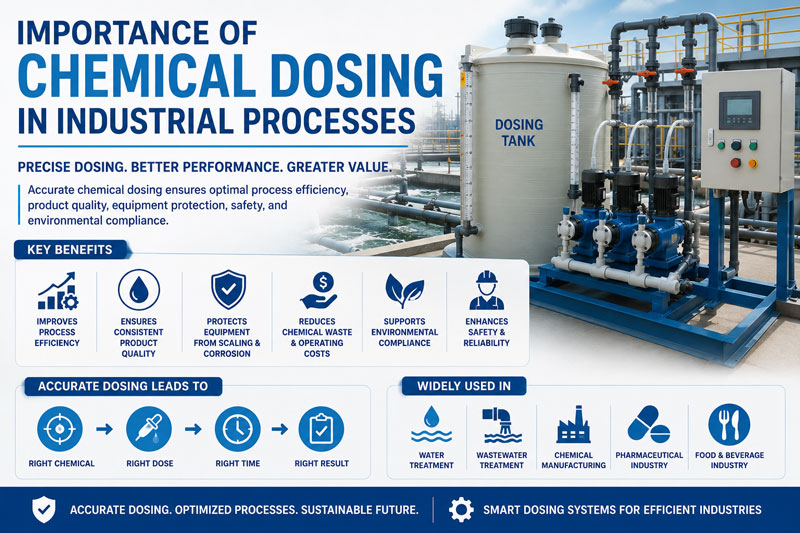
Chemical dosing plays a crucial role in modern industrial operations. From water treatment and wastewater treatment to chemical manufacturing and food processing, precise chemical dosing ensures consistent product quality, process efficiency, operational safety, and regulatory compliance.
Accurate chemical dosing is the controlled addition of chemicals in the correct quantity at the right time to achieve a desired process outcome. Proper dosing improves process performance, reduces waste, minimizes operational costs, and helps industries maintain environmental and safety standards.
As industries continue to focus on efficiency and sustainability, accurate chemical dosing has become a critical factor in achieving reliable and cost-effective operations.
Quick Overview
| Factor | Impact of Accurate Chemical Dosing |
|---|---|
| Process Efficiency | Improved performance and consistency |
| Chemical Consumption | Reduced waste and optimized usage |
| Product Quality | Consistent production results |
| Equipment Protection | Reduced scaling and corrosion |
| Environmental Compliance | Better treatment effectiveness |
| Operating Costs | Lower chemical and maintenance expenses |
| Workplace Safety | Safer chemical handling and storage |
What Is Chemical Dosing?
Chemical dosing is the process of adding specific quantities of chemicals into a system, process stream, or treatment facility to achieve a particular objective.
Depending on the application, chemicals may be used for:
- pH adjustment
- Water treatment
- Wastewater treatment
- Disinfection
- Neutralization
- Corrosion control
- Scale prevention
- Process enhancement
The effectiveness of these processes depends heavily on maintaining accurate dosing levels.
Why Accurate Chemical Dosing Matters
Industrial processes often rely on precise chemical reactions and treatment conditions. Even small variations in dosing can affect process performance, increase costs, and create operational challenges.
Proper chemical dosing helps ensure:
- Consistent treatment results
- Stable process conditions
- Reduced chemical waste
- Better resource utilization
- Compliance with environmental regulations
In many industries, dosing accuracy directly impacts profitability and operational reliability.
The Risks of Overdosing and Underdosing
Overdosing
Adding excessive amounts of chemicals can create several problems:
- Increased operating costs
- Chemical wastage
- Product contamination
- Equipment damage
- Environmental compliance issues
For example, excessive coagulant dosing in water treatment can increase sludge generation and disposal costs.
Underdosing
Insufficient chemical dosing can result in:
- Poor treatment performance
- Incomplete reactions
- Regulatory non-compliance
- Reduced product quality
- Increased process instability
Both overdosing and underdosing can significantly impact operational efficiency.
Key Benefits of Accurate Chemical Dosing
Improved Process Efficiency
Precise dosing helps maintain optimal operating conditions throughout the process.
Benefits include:
- Stable process performance
- Reduced variability
- Higher production efficiency
- Better process control
Reduced Chemical Consumption
One of the most significant advantages of accurate dosing is minimizing chemical waste.
By applying only the required amount of chemicals, industries can:
- Lower operating costs
- Reduce inventory requirements
- Improve resource efficiency
Consistent Product Quality
In manufacturing operations, precise dosing helps maintain consistent product specifications.
This is especially important in industries such as:
- Chemical manufacturing
- Pharmaceuticals
- Food processing
- Water treatment
Enhanced Equipment Protection
Many industrial chemicals are used to control corrosion, scaling, and fouling.
Accurate dosing helps:
- Protect pipelines
- Extend equipment life
- Reduce maintenance requirements
- Prevent unexpected failures
Better Environmental Compliance
Environmental regulations often require specific treatment standards before wastewater or emissions can be discharged.
Proper dosing ensures:
- Effective contaminant removal
- Regulatory compliance
- Reduced environmental impact
Industries That Depend on Accurate Chemical Dosing
Water Treatment Plants
Water treatment facilities rely on chemical dosing for:
- Coagulation
- Flocculation
- pH control
- Disinfection
Precise dosing ensures safe and high-quality water production.
Wastewater Treatment Facilities
Wastewater treatment processes require accurate dosing to remove contaminants and meet discharge standards.
Common dosing applications include:
- Neutralization
- Odor control
- Nutrient removal
- Sludge conditioning
Chemical Manufacturing
Chemical production processes often depend on carefully controlled dosing to maintain reaction efficiency and product quality.
Pharmaceutical Industry
Pharmaceutical manufacturing requires highly accurate dosing to ensure product consistency and compliance with strict quality standards.
Food and Beverage Processing
Chemical dosing is used for sanitation, water treatment, and process control throughout food production operations.
Common Challenges in Chemical Dosing
Industrial facilities frequently face challenges that affect dosing accuracy.
These include:
- Manual dosing errors
- Inconsistent chemical concentrations
- Equipment calibration issues
- Variable process conditions
- Improper storage practices
- Poor system maintenance
Addressing these challenges requires proper system design and monitoring.
The Role of Dosing Tanks in Accurate Chemical Dosing
Dosing tanks are an essential component of chemical dosing systems.
They provide safe and controlled storage of treatment chemicals before injection into the process.
A properly designed dosing tank helps ensure:
- Consistent chemical concentration
- Reliable dosing performance
- Safe chemical handling
- Reduced contamination risks
Modern dosing tanks are commonly manufactured using corrosion-resistant materials such as FRP and thermoplastics to withstand aggressive chemicals.
Essential Components of a Chemical Dosing System
A typical chemical dosing system includes:
Dosing Tank
Stores the chemical solution safely.
Dosing Pump
Controls the injection rate of chemicals.
Mixing Equipment
Ensures uniform chemical concentration.
Monitoring Instruments
Measure process parameters and dosing performance.
Control Systems
Automate dosing based on process requirements.
Together, these components help maintain accurate and reliable dosing operations.
Best Practices for Accurate Chemical Dosing
Industries can improve dosing performance by following several best practices.
Conduct Regular Calibration
Calibration ensures dosing pumps and monitoring instruments operate accurately.
Monitor Process Parameters
Continuous monitoring allows operators to adjust dosing rates as process conditions change.
Use High-Quality Dosing Equipment
Reliable equipment reduces dosing errors and improves system performance.
Maintain Proper Chemical Storage
Proper storage helps preserve chemical quality and effectiveness.
Automate Dosing Operations
Automation improves precision while reducing human error.
Why FRP Dosing Tanks Are Preferred
Fiberglass Reinforced Plastic (FRP) dosing tanks are widely used in industrial applications because of their superior durability and corrosion resistance.
Benefits include:
- Excellent chemical resistance
- Lightweight construction
- Long service life
- Low maintenance requirements
- Cost-effective operation
These advantages make FRP dosing tanks ideal for chemical processing, water treatment, and wastewater treatment facilities.
Frequently Asked Questions
What is chemical dosing?
Chemical dosing is the controlled addition of chemicals into a process or treatment system to achieve specific operational objectives.
Why is accurate chemical dosing important?
Accurate dosing improves process efficiency, reduces waste, ensures product quality, and helps maintain regulatory compliance.
What industries use chemical dosing systems?
Water treatment, wastewater treatment, chemical manufacturing, pharmaceuticals, food processing, and power generation industries commonly use dosing systems.
What happens if chemicals are overdosed?
Overdosing can increase costs, damage equipment, reduce efficiency, and create compliance issues.
What role do dosing tanks play?
Dosing tanks safely store chemicals and help maintain consistent chemical concentrations for accurate dosing.
Conclusion
Accurate chemical dosing is essential for achieving efficient, safe, and cost-effective industrial operations. By ensuring the right amount of chemicals is added at the correct time, industries can improve process performance, reduce operating costs, protect equipment, and maintain compliance with environmental regulations.
Whether in water treatment, wastewater treatment, chemical manufacturing, or other industrial applications, investing in reliable dosing systems and properly designed dosing tanks can significantly enhance operational efficiency and long-term reliability.
Nivra Envirotech Pvt. Ltd. manufactures high-performance dosing tanks, chemical storage tanks, and corrosion-resistant process equipment for industrial, water treatment, and wastewater treatment applications. Our customized solutions are engineered to deliver safe chemical handling, reliable performance, and long service life in demanding operating environments.
- chemical dosing pumps
- chemical dosing systems
- chemical management systems
- chemical storage tanks
- corrosion resistant dosing tanks
- dosing tanks
- FRP dosing tanks
- industrial chemical dosing
- industrial process control
- industrial water treatment
- process efficiency
- wastewater treatment dosing
- wastewater treatment equipment
- water treatment dosing