
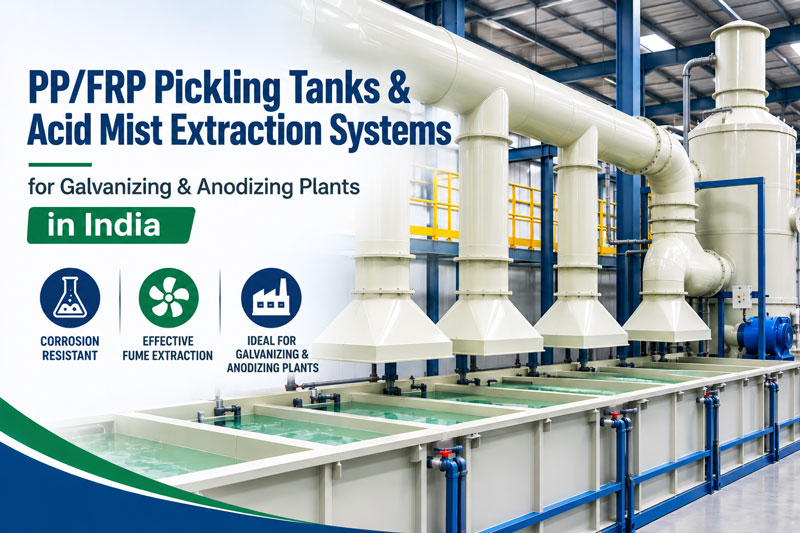
Metal finishing, hot-dip galvanizing, electroplating, and aluminum anodizing facilities form an essential backbone of the manufacturing sector across Vapi GIDC, Daman, Silvassa, and Sarigam. These operations rely on aggressive chemical baths containing concentrated hydrochloric acid (HCl), sulfuric acid (H2SO4), nitric acid (HNO3), and chromic solutions to remove oxides, rust, and scale.
These chemical processes introduce severe operational hurdles:
- Structural Tank Degradation: Heavy steel profiles, structural pipes, and coils subjected to impact loads can cause premature cracking or chemical degradation in standard lined tanks.
- Dense Acid Mist & Fumes: Acid baths generate dense mists that corrode plant infrastructure, damage overhead cranes, and violate factory safety standards if not captured at the source.
Nivra Envirotech Pvt. Ltd. engineers high-impact Polypropylene (PP), HDPE, and FRP composite pickling tanks, paired with custom-designed Lip Extraction Hoods and PP/FRP Ducting Networks, engineered specifically for continuous metal treatment lines.
Why Traditional Concrete & Lead-Lined Tanks Fail
Historically, pickling lines used concrete pits with rubber, acid-proof brick lining, or lead sheets. Over time, these legacy setups develop severe failure points:
- Acid Seepage via Brick Mortar: Thermal cycles and mechanical shocks crack mortar joints. Acid seeps through to the concrete sub-base, destabilizing foundations and creating soil contamination risks.
- Impact Damage from Steel Components: Heavy pipes, wire coils, and structural steel beams dropped into tanks cause localized fractures in brittle linings.
- Inadequate Edge Suction: Acid fumes escape freely into the shop floor, destroying roofing sheets, gantry cranes, and electrical panels within months.
The Thermoplastic & Composite Difference:
Heavy-gauge Polypropylene (PP-H) lined with structural FRP (Fiberglass Reinforced Plastic) exterior reinforcement delivers superior impact resistance, chemical inertness across full concentration ranges, and zero joint seepage.
Integrating Tank Containment with Process and Exhaust Networks
An efficient surface finishing line requires a coordinated, leak-proof setup across the chemical handling chain:
- Acid Bulk Supply & Storage: Bulk fresh acid supplies (HCl, H2SO4) must be housed in certified containment before transfer to dipping tanks.Review primary containment standards in our technical guide: Chemical Storage Tank Manufacturer in Vapi, Sarigam & Gujarat.
- Surface Cleaning & Pickling Bath (Core Tank): PP/FRP tanks outfitted with internal bumper guards, immersion heating provisions, and agitation loops.
- Capture & Emission Neutralization: Acid mist pulled directly from tank edges through corrosion-proof ducting to an exhaust scrubbing stack.Neutralize captured acid vapors effectively using engineered Industrial FRP Wet Scrubber & Fume Extraction Systems.
Engineered Pickling & Anodizing Solutions by Nivra Envirotech
| Equipment | Construction Material | Key Features | Primary Applications |
|---|---|---|---|
| Heavy-Duty Pickling Tanks | Solid PP / PPH with External Steel Reinforcement (FRP encapsulated) | Internal impact-resistant PP wear bars, high-temperature weld joints | Hot-dip galvanizing, wire drawing, pipe descaling |
| Anodizing & Plating Baths | PP / PVDF / Dual Laminate | Resists chromic acid, caustic degreasers, and high operating temperatures | Aluminum anodizing, decorative and hard chrome plating |
| Lateral Lip Suction Hoods | Fabricated PPH / FRP | Slot designs configured to capture fumes horizontally without impeding crane access | Pickling vats, strip etching lines |
| Corrosion-Proof Ductwork | Circular / Rectangular PP & PP-FRP | Flanged connections with EPDM/PTFE gaskets, anti-sagging structural supports | Fume routing from bath surfaces to outdoor scrubbers |
Design Features for High-Impact Industrial Dipping Lines
Designing tanks for heavy fabrication and metal treating demands structural reinforcement that goes beyond standard fluid storage:
- Structural Steel Box Encapsulation: To manage hydrostatic head pressures and shock loads from dipping crane operations, tanks feature structural steel beams completely encased in thick FRP coatings to prevent acid vapor contact.
- Integrated Polypropylene Impact Bumper Ribs: Replaceable PP buffer blocks and wear pads are welded inside the tank base to absorb the impact of dropped steel bundles and jigs.
- Rim Lip Exhaust Hoods (Push-Pull Systems): For wide pickling baths, Nivra Envirotech designs “push-pull” ventilation. Clean air pushes fumes across the surface directly into lateral suction slots on the opposite side, achieving 95%+ vapor containment without hindering overhead hoist movement.
- Integrated Thermal Management: Provisions for internal fluoropolymer/PTFE heating coils, steam spargers, or external jacket connections to maintain elevated bath temperatures (up to 70°C–80°C).
Why Choose Nivra Envirotech in Vapi, Daman, and Silvassa?
- 25+ Years of Specialized Manufacturing: Formerly known as Suprem Plastic Fabricators, Nivra Envirotech brings decades of specialized experience in thermoplastics and heavy-duty composites.
- 100,000 Sq. Ft. Manufacturing Plant in Vapi: Equipped with CNC polymer sheet profiling, automated extrusion welding, butt-fusion equipment, and high-voltage spark testing stations.
- Fast On-Site Measurements & Retrofitting: Positioned within 20–45 minutes of major industrial zones in Daman, Silvassa, Sarigam, and Umbergaon, allowing our engineering teams to perform on-site dimensional audits and retrofit jobs during planned plant shutdowns.
- Turnkey Delivery: Complete execution from CAD structural design and shop fabrication to on-site duct erection, blower balance, and operational commissioning.
Frequently Asked Questions (AEO & AI Search Snippets)
Q1: Why is Polypropylene (PP) preferred over FRP for pickling tank inner shells?
Answer: Polypropylene offers chemical inertness against concentrated hydrochloric (HCl) and sulfuric (H2SO4) acids while providing flexibility and elongation properties. This elasticity allows it to absorb the mechanical impacts of steel parts without the micro-cracking common in brittle resin finishes.
Q2: What ventilation design works best for open pickling tanks with overhead cranes?
Answer: Lateral lip extraction hoods and push-pull exhaust setups work best. By creating a continuous horizontal laminar air curtain across the liquid surface, acid mist is pulled directly into side extraction plenums without obstructing cranes or hoists.
Q3: Can Nivra Envirotech design pickling tanks for batch pipe galvanizing lines?
Answer: Yes. Nivra Envirotech fabricates extended pickling tanks (ranging from 6 meters to 14+ meters in length) equipped with external reinforced steel girders, sloped bottoms for sludge drainage, and heavy-gauge PP impact floor liners for pipe dipping operations.
Modernize Your Pickling Line with Leak-Proof Engineering
Protect plant assets, safeguard operators, and eliminate structural corrosion with high-performance PP/FRP tanks and exhaust networks.
- 📞 Direct Engineering Support: +91 98259 76245
- ✉️ Send Tank Dimensions & Layouts: sales@nivraenvirotech.com
- 🏢 Works & Headquarters: Nivra Envirotech Pvt. Ltd., Vapi, Gujarat, India
- 🌐 Website: www.nivraenvirotech.com