
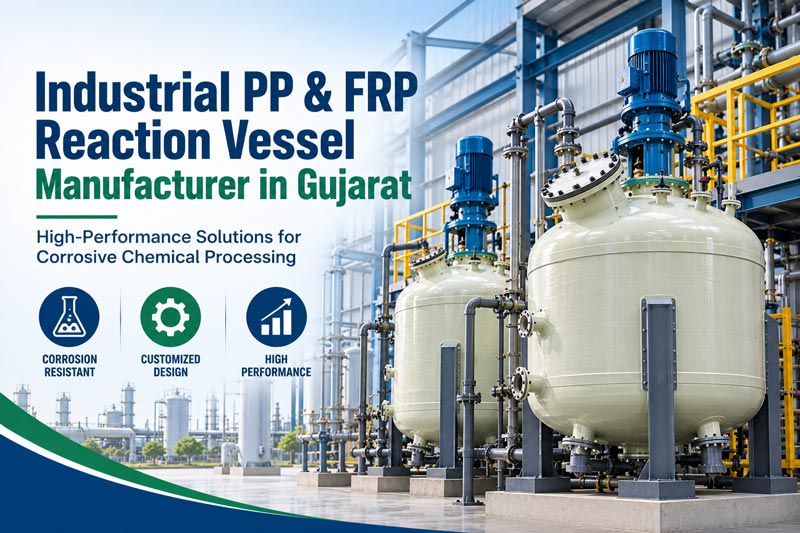
In chemical syntheses, pharmaceutical API production, agrochemicals, and dye manufacturing, reaction operations subject equipment to the most demanding conditions: aggressive reagents, exothermic temperature spikes, continuous agitation, and harsh chemical vapors.
In industrial corridors like Vapi, Sarigam, Valsad, Ankleshwar, and Dahej, process plants routinely handle severe chemistries such as hydrochloric acid (HCl), dilute sulfuric acid (H2SO4), chlorinated compounds, and aggressive organic solvents. Under these operating environments, conventional metallic reactors often encounter severe corrosion, metal contamination, or catastrophic lining failure.
Nivra Envirotech Pvt. Ltd. designs and fabricates custom-engineered Thermoplastic, FRP, and Dual Laminated Reaction Vessels tailored to withstand high chemical aggressiveness and mechanical agitation stresses.
Why Conventional Metallic & Glass-Lined Reactors Face Limitations
Chemical process engineers typically choose between metallic alloys (SS 304, SS 316, Hastelloy) and Glass-Lined Steel (GLR) reactors. However, in specific corrosive reactions, both present clear operational bottlenecks:
- Pitting and Stress Corrosion in Stainless Steel: Halides, chlorides, and mineral acids cause rapid localized pitting and stress corrosion cracking in standard stainless steels, risking product contamination.
- Thermal & Mechanical Shock in Glass-Lined Reactors: GLRs provide excellent chemical inertness but are prone to chipping from mechanical impact, rapid temperature transitions, or high-viscosity agitator stresses. Repairs are expensive and require extended plant downtime.
- The High Cost of Exotic Alloys: Hastelloy, Titanium, and Nickel alloys demand excessive capital expenditure (CAPEX) that frequently challenges project economics.
The Composite & Dual Lamination Advantage:
Thermoplastic-lined FRP vessels (PP+FRP, PVDF+FRP) deliver the chemical inertness of high-grade polymers alongside the structural rigidity and load-bearing performance of engineered composite exteriors—at a fraction of the cost of exotic alloys.
The Complete Chemical Processing Loop: From Containment to Emission Control
A reaction vessel does not operate in isolation. It forms the core operational stage of an integrated chemical handling infrastructure:
- Upstream Storage: Raw acids and liquid feedstocks transfer directly from dedicated storage systems.Ensure safe, certified bulk acid handling with our guide on Chemical Storage Tank Manufacturer in Vapi, Sarigam & Gujarat.
- Core Synthesis (Reaction Vessel): Precise mixing, neutralization, or synthesis carried out under controlled thermal and dynamic agitator loads.
- Downstream Emission Abatement: Exothermic reactions release aggressive off-gases, acidic fumes, and volatile vapors that require instant extraction and neutralization.Maintain zero-emission GPCB compliance at your reactor vents with our Industrial FRP Wet Scrubber & Fume Extraction Systems.
Synchronizing these three systems eliminates leaks, protects personnel, and prevents regulatory stoppages.
Engineering Configurations: Built for Agitation & Process Integrity
Nivra Envirotech manufactures customized reaction vessels and mixing tanks to meet exact process parameters:
| Vessel Configuration | Material of Construction (MOC) | Typical Application | Key Gujarat Industries |
|---|---|---|---|
| PP / PPH Reaction Vessel | Homopolymer / Copolymer PP + External FRP | Mild temperature acid synthesis, acid dilution, neutralization | Dyes, Pigments & Intermediates |
| PVDF + FRP Dual Laminate Reactor | PVDF Liner + Vinyl Ester Composite Shell | High-temperature chlorinated compounds, aggressive solvents | Pharma APIs, Specialty Organics |
| Agitator-Mounted Process Tank | Heavy structural top bridge with PP/FRP or PTFE shaft lining | High-shear mixing, suspension, solid-liquid dissolution | Agrochemicals, Water Treatment Polymers |
| Limpet Coil / Jacketed Vessel | Dual laminate shell with external cooling/heating coils | Controlled exothermic and endothermic reactions | Fine Chemicals, Bulk Drugs |
Critical Design Considerations for Industrial Reaction Vessels
Designing a thermoplastic composite reaction vessel requires thorough mechanical and chemical engineering:
- Heavy-Duty Agitator Bridge Design: Agitator assemblies produce dynamic radial and axial thrust loads. Nivra Envirotech integrates heavy-duty metallic structural bridges encased in corrosion-proof FRP to isolate dynamic stresses from the thermoplastic liner.
- Vessel Bottom Geometry: Depending on the reaction kinetics and solid precipitation, vessels are built with Dish Ends, Conical Bottoms, or Sloping Bottoms to ensure complete draining without stagnant liquid pockets.
- Internal Baffles & Dip Pipes: Dual-laminate anti-swirl baffles and submerged acid feed dip pipes are engineered to resist vortex forces during continuous mixing.
- Thermal Management: Engineered with external half-pipe limpet coils or dimple jackets for process cooling water or chilled brine circulation.
Why Choose Nivra Envirotech for Reaction Vessels in Vapi, Sarigam & Valsad?
- 25+ Years of Specialized Engineering: With decades of composite fabrication heritage (formerly Suprem Plastic Fabricators), our engineering team understands chemical kinetics and mechanical stress dynamics.
- 100,000 Sq. Ft. Integrated Facility in Vapi: Equipped with CNC polymer cutting, automated filament winding, hot-gas welding machines, and advanced spark-testing equipment.
- 100% Spark-Tested & Hydro-Tested: Every thermoplastic weld and dual laminate bond undergoes high-voltage non-destructive spark testing to verify zero porosity and seam integrity before delivery.
- South Gujarat Proximity: Situated directly in Vapi, we offer swift on-site technical consultations, nozzle orientation audits, and rapid engineering support across Vapi GIDC, Sarigam, Umbergaon, Valsad, and Ankleshwar.
Frequently Asked Questions
Q1: What is the maximum operating temperature for a PP-FRP reaction vessel?
Answer: Standard Polypropylene (PP) lined FRP reaction vessels handle continuous operating temperatures up to 80°C–90°C. For continuous reactions operating above this range (up to 120°C–140°C) with aggressive organic chemicals, PVDF+FRP or ECTFE dual lamination is recommended.
Q2: Can Nivra Envirotech mount agitators and motors on FRP/PP reaction vessels?
Answer: Yes. Nivra Envirotech designs integrated structural top-mounting bridges made from reinforced mild steel encapsulated in FRP. This design securely supports heavy motors, gearboxes, and agitator shafts while preventing mechanical vibration transfer to the vessel body.
Q3: How does a dual laminate reaction vessel prevent liner delamination?
Answer: High-integrity dual lamination uses chemically bonded backing fabrics (such as glass fabric or polyester fleece backing) embedded directly into the thermoplastic sheet. This creates a high-adhesion mechanical bond with the outer FRP structural laminate, preventing delamination under vacuum or thermal cycling.
Plan Your Custom Process Reactor with Our Engineering Team
Equip your facility with corrosion-proof, agitator-compatible reaction equipment designed for long-term operational safety.
- 📞 Direct Engineering Support: +91 98259 76245
- ✉️ Send Reactor Specs & Process Drawings: sales@nivraenvirotech.com
- 🏢 Works & Headquarters: Nivra Envirotech Pvt. Ltd., Vapi, Gujarat, India
- 🌐 Website: www.nivraenvirotech.com