
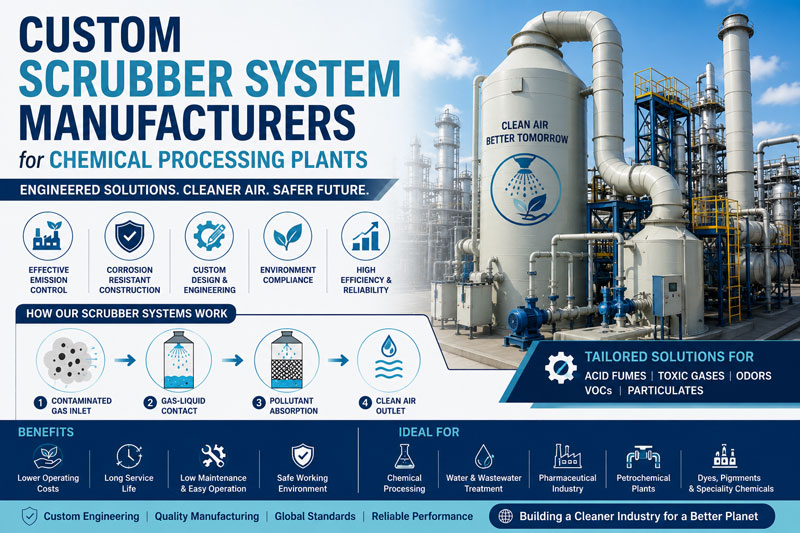
Industrial facilities across the world face increasing pressure to reduce emissions, improve workplace safety, and comply with environmental regulations. Whether in chemical manufacturing, wastewater treatment, pharmaceuticals, petrochemicals, or metal processing, controlling harmful gases and airborne pollutants is a critical requirement for sustainable operations.
Scrubber system manufacturers play a vital role in helping industries achieve effective air pollution control by designing and supplying customized gas scrubbing systems, wet scrubbers, packed bed scrubbers, and FRP scrubbers that remove toxic gases, chemical fumes, odors, and particulate contaminants from industrial exhaust streams.
As environmental standards become stricter across the Middle East, Africa, and global industrial markets, choosing the right scrubber system manufacturer has become more important than ever.
Quick Overview of Industrial Scrubber Systems
| Feature | Benefit |
|---|---|
| Toxic Gas Removal | Improved air quality |
| Odor Control | Safer working environment |
| Emission Reduction | Regulatory compliance |
| Corrosion Resistance | Longer equipment life |
| FRP Construction | Low maintenance |
| Customized Design | Industry-specific solutions |
| High Efficiency | Reduced environmental impact |
What Is a Scrubber System?
A scrubber system is an air pollution control solution designed to remove harmful pollutants from industrial exhaust gases before they are released into the atmosphere.
These systems are commonly used to eliminate:
- Acid fumes
- Toxic gases
- Chemical vapors
- Odors
- Particulate matter
- Hazardous air pollutants
Industrial scrubbers are widely installed in facilities where chemical processes generate emissions that could impact worker safety, equipment performance, or environmental compliance.
Why Industries Need Industrial Scrubber Systems
Modern industrial operations must address several air quality challenges.
Common concerns include:
- Environmental regulations
- Worker exposure to hazardous gases
- Community odor complaints
- Equipment corrosion
- Emission control requirements
Installing an efficient industrial scrubber system helps industries reduce these risks while improving overall operational sustainability.
Types of Scrubber Systems Manufactured for Industrial Applications
Wet Scrubber Systems
Wet scrubbers use water or chemical solutions to absorb and neutralize pollutants.
Applications include:
- Chemical plants
- Wastewater treatment facilities
- Pharmaceutical manufacturing
- Metal finishing operations
Benefits include:
- High removal efficiency
- Effective odor control
- Multi-pollutant treatment capability
Packed Bed Scrubbers
Packed bed scrubbers contain specially engineered packing media that maximize contact between gas and liquid.
Advantages include:
- High absorption efficiency
- Low pressure drop
- Suitable for corrosive gases
- Continuous operation capability
Packed bed scrubbers are among the most commonly installed air pollution control systems in chemical industries.
FRP Scrubbers
FRP scrubbers are manufactured using Fiberglass Reinforced Plastic to provide superior corrosion resistance.
Benefits include:
- Lightweight construction
- Long service life
- Low maintenance
- Excellent resistance to acids and alkalis
FRP scrubber systems are particularly suitable for highly corrosive industrial environments.
Chemical Fume Scrubbers
Chemical fume scrubbers are designed to capture and neutralize hazardous fumes generated during industrial processing operations.
These systems are commonly used in:
- Chemical manufacturing plants
- Electroplating facilities
- Pickling operations
- Laboratory exhaust systems
Key Factors to Consider When Choosing Scrubber System Manufacturers
Not all scrubber manufacturers offer the same level of engineering expertise and customization capabilities.
Before selecting a supplier, industries should evaluate the following factors.
Engineering Experience
Choose a manufacturer with proven experience in designing air pollution control systems for your industry.
Experienced manufacturers understand:
- Gas characteristics
- Chemical compatibility
- Regulatory requirements
- Operational challenges
Custom Design Capabilities
Every industrial process generates unique emissions.
A reliable scrubber system manufacturer should provide:
- Custom sizing
- Process-specific design
- Tailored treatment solutions
- Future expansion options
Material Expertise
Material selection is critical for long-term performance.
Leading manufacturers typically offer:
- FRP scrubbers
- Thermoplastic scrubbers
- Dual laminate scrubbers
- Corrosion-resistant process equipment
Manufacturing Quality
High-quality fabrication directly impacts system performance and lifespan.
Look for manufacturers that maintain:
- Quality assurance procedures
- Advanced fabrication facilities
- Skilled engineering teams
- Industry-standard manufacturing practices
After-Sales Support
Long-term support is essential for maximizing system performance.
Important services include:
- Installation assistance
- Performance optimization
- Maintenance support
- Spare parts availability
Industries Served by Scrubber System Manufacturers
Chemical Manufacturing Industry
Chemical plants generate various hazardous emissions including:
- Hydrochloric acid fumes
- Sulfur dioxide
- Ammonia
- Chlorine gas
Scrubbing systems help control these pollutants effectively.
Wastewater Treatment Plants
Wastewater treatment facilities commonly produce:
- Hydrogen sulfide
- Ammonia
- Odorous compounds
Industrial scrubbers improve air quality and reduce odor complaints.
Water Treatment Facilities
Water treatment plants often require emission control systems for chlorine handling and chemical treatment operations.
Pharmaceutical Industry
Pharmaceutical manufacturing processes may release solvent vapors and process-related emissions that require specialized treatment.
Petrochemical Industry
Petrochemical facilities rely on advanced gas scrubbing systems to maintain environmental compliance and operational safety.
Why FRP Scrubber Systems Are Preferred
Many industrial facilities choose FRP scrubbers because they offer significant advantages over traditional metal systems.
Excellent Corrosion Resistance
FRP materials withstand aggressive chemical environments.
Lower Maintenance Costs
Corrosion-resistant construction reduces maintenance requirements.
Long Operational Life
FRP scrubbers provide reliable performance for many years.
Lightweight Construction
Installation and transportation are easier compared to metallic alternatives.
Cost-Effective Ownership
Reduced maintenance and longer service life improve overall return on investment.
Benefits of Working with Experienced Scrubber System Manufacturers
Partnering with a qualified manufacturer provides several advantages.
Better Regulatory Compliance
Well-designed systems help industries meet emission standards.
Improved Air Quality
Effective pollutant removal supports healthier workplaces.
Reduced Operating Costs
Efficient designs minimize energy and maintenance expenses.
Customized Solutions
Tailored systems deliver better performance for specific applications.
Long-Term Reliability
Quality manufacturing ensures dependable operation over the system lifecycle.
Emerging Trends in Industrial Air Pollution Control
The air pollution control industry continues to evolve with advancements in:
- Smart monitoring systems
- Automated process control
- High-efficiency packed media
- Energy-efficient designs
- Advanced corrosion-resistant materials
Modern scrubber system manufacturers are increasingly integrating these technologies to improve performance and sustainability.
Frequently Asked Questions
What does a scrubber system manufacturer do?
A scrubber system manufacturer designs, fabricates, and supplies industrial air pollution control systems that remove harmful gases, fumes, odors, and airborne contaminants.
Which industries use scrubber systems?
Chemical manufacturing, wastewater treatment, pharmaceuticals, petrochemicals, water treatment, and metal processing industries commonly use scrubber systems.
What is the most common type of industrial scrubber?
Wet scrubbers and packed bed scrubbers are among the most widely used industrial air pollution control systems.
Why are FRP scrubbers preferred?
FRP scrubbers offer superior corrosion resistance, long service life, low maintenance, and cost-effective operation.
How do scrubber systems help environmental compliance?
They reduce harmful emissions and help facilities meet local and international air quality regulations.
Conclusion
Industrial scrubber systems are essential for controlling emissions, improving workplace safety, and ensuring environmental compliance. Choosing the right scrubber system manufacturer is critical for achieving long-term performance, reliability, and operational efficiency.
Industries involved in chemical manufacturing, wastewater treatment, water treatment, pharmaceuticals, and petrochemicals should prioritize manufacturers with strong engineering expertise, customization capabilities, and proven experience in air pollution control technologies.
Nivra Envirotech Pvt. Ltd. is a trusted manufacturer of industrial scrubber systems, FRP scrubbers, packed bed scrubbers, and air pollution control solutions. Our customized systems are engineered to deliver superior emission control, corrosion resistance, and reliable long-term performance for demanding industrial applications across India, the Middle East, Africa, and global markets.
- air pollution control systems
- chemical fume scrubbers
- chemical industry scrubbers
- environmental compliance solutions
- FRP scrubber manufacturer
- FRP scrubbers
- gas scrubbing systems
- industrial air quality management
- industrial emission control
- industrial scrubber systems
- packed bed scrubbers
- pollution control equipment
- scrubber system manufacturers
- wastewater treatment scrubbers
- wet scrubber systems