
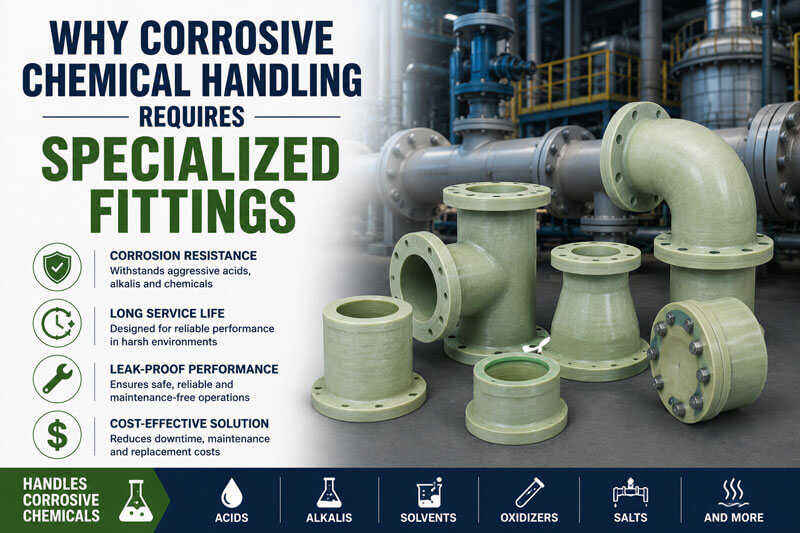
Handling corrosive chemicals safely and efficiently is one of the biggest challenges faced by modern industries. Chemical processing plants, wastewater treatment facilities, pharmaceuticals, metal finishing units, and petrochemical industries all require piping systems capable of withstanding aggressive chemicals without failure.
While pipes play a critical role in fluid transport, pipe fittings are equally important because they connect, direct, regulate, and control the flow of corrosive liquids throughout the piping network.
FRP pipe fittings have become the preferred solution for corrosive chemical handling because they offer exceptional corrosion resistance, long service life, low maintenance requirements, and superior performance in harsh industrial environments.
As industrial development continues across Vapi, Gujarat, India, and expanding manufacturing sectors in Saudi Arabia, UAE, Oman, Qatar, Kuwait, South Africa, Kenya, Nigeria, Egypt, Indonesia, Vietnam, and other global markets, demand for FRP piping systems and fittings continues to grow.
Quick Overview
| Feature | FRP Pipe Fittings |
|---|---|
| Corrosion Resistance | Excellent |
| Chemical Compatibility | Wide Range |
| Weight | Lightweight |
| Maintenance | Low |
| Service Life | Long |
| Installation | Easy |
| Applications | Chemical, Water Treatment, Wastewater, Petrochemical |
What Are FRP Pipe Fittings?
FRP (Fiberglass Reinforced Plastic) pipe fittings are specialized components used to connect, change direction, branch, reduce, or terminate piping systems that transport corrosive chemicals and industrial fluids.
These fittings are manufactured using high-strength fiberglass reinforcement combined with corrosion-resistant resin systems.
Common FRP fittings include:
- Elbows
- Tees
- Reducers
- Flanges
- Couplings
- Unions
- End Caps
- Stub Ends
- Cross Fittings
Together, these components form a complete piping network capable of handling aggressive chemical environments.
Why Corrosive Chemical Handling Requires Specialized Fittings
Many industrial chemicals can rapidly attack traditional metal piping systems.
Common corrosive substances include:
- Sulfuric Acid
- Hydrochloric Acid
- Nitric Acid
- Caustic Soda
- Ferric Chloride
- Sodium Hypochlorite
- Chemical Solvents
When conventional materials are exposed to these chemicals, they may experience:
- Corrosion
- Leaks
- Structural failure
- Product contamination
- Increased maintenance costs
FRP fittings are specifically engineered to overcome these challenges.
Advantages of FRP Pipe Fittings
Exceptional Corrosion Resistance
The primary advantage of FRP fittings is their ability to resist corrosion caused by aggressive chemicals.
Unlike metal fittings, FRP does not rust or deteriorate when exposed to many acids, alkalis, and chemical solutions.
Long Service Life
FRP pipe fittings are designed to perform reliably for many years even in demanding industrial environments.
This helps reduce:
- Replacement costs
- Maintenance expenses
- Downtime
Lightweight Construction
FRP fittings are significantly lighter than steel and other metallic alternatives.
Benefits include:
- Easier handling
- Faster installation
- Lower transportation costs
- Reduced structural loading
Low Maintenance Requirements
Corrosion-resistant construction minimizes maintenance needs and extends operational life.
Excellent Mechanical Strength
Modern FRP fittings provide high strength while maintaining lightweight properties.
This combination makes them suitable for demanding industrial applications.
Common Types of FRP Pipe Fittings
FRP Elbows
Used to change flow direction within the piping system.
Available in:
- 45° Elbows
- 90° Elbows
- Custom Angle Elbows
FRP Tees
Allow fluid distribution into multiple flow paths.
Applications include:
- Process plants
- Chemical transfer systems
- Water treatment facilities
FRP Reducers
Used to connect different pipe sizes while maintaining flow efficiency.
FRP Flanges
Provide removable connections for equipment and piping systems.
Advantages include:
- Easy maintenance
- Leak-resistant joints
- Flexible installation
FRP End Caps
Used to seal pipe ends safely and securely.
Industries Using FRP Pipe Fittings
Chemical Manufacturing Industry
Chemical plants rely heavily on FRP fittings for handling corrosive process chemicals.
Applications include:
- Acid transfer lines
- Chemical storage systems
- Process piping networks
Industrial clusters such as Vapi, Gujarat use extensive FRP piping systems due to the concentration of chemical manufacturers.
Wastewater Treatment Plants
Wastewater facilities require corrosion-resistant piping solutions for:
- Chemical dosing systems
- Effluent handling
- Treatment processes
Water Treatment Plants
FRP fittings support:
- Chemical feed systems
- Filtration units
- Treatment infrastructure
Pharmaceutical Industry
Pharmaceutical manufacturers use FRP systems where corrosion resistance and cleanliness are important.
Petrochemical Industry
Petrochemical plants require durable piping systems capable of handling aggressive process conditions.
FRP vs Metal Pipe Fittings
| Feature | FRP Pipe Fittings | Metal Pipe Fittings |
|---|---|---|
| Corrosion Resistance | Excellent | Limited |
| Weight | Lightweight | Heavy |
| Maintenance | Low | Higher |
| Service Life | Long | Moderate |
| Chemical Compatibility | Wide Range | Limited |
| Installation Cost | Lower | Higher |
For corrosive environments, FRP fittings often provide a more economical long-term solution.
Factors to Consider When Selecting FRP Pipe Fittings
Chemical Compatibility
The fitting material must be compatible with the chemicals being handled.
Temperature Requirements
Operating temperatures influence resin selection and overall design.
Pressure Conditions
Fittings should be designed for expected operating pressures.
Pipe Size and Flow Requirements
Proper sizing ensures efficient flow and system performance.
Environmental Conditions
Outdoor installations may require UV-resistant designs.
Benefits of FRP Pipe Fittings in Wastewater and Chemical Industries
Reduced Downtime
Corrosion-resistant systems experience fewer failures.
Improved Safety
Leak-resistant fittings help reduce workplace hazards.
Lower Lifecycle Costs
Long service life improves return on investment.
Better Process Reliability
Consistent performance supports uninterrupted operations.
Environmental Protection
Reliable containment helps prevent chemical leaks and contamination.
Why FRP Pipe Fittings Are Growing in Demand Globally
Industries worldwide are increasingly replacing traditional metal piping systems with FRP solutions.
Growing demand is being driven by:
- Stricter environmental regulations
- Higher maintenance costs for metal systems
- Increasing chemical processing activities
- Expansion of wastewater treatment infrastructure
- Focus on long-term asset reliability
Countries experiencing strong demand include:
- India
- Saudi Arabia
- UAE
- Oman
- Qatar
- Kuwait
- South Africa
- Kenya
- Nigeria
- Egypt
- Indonesia
- Malaysia
- Vietnam
Frequently Asked Questions
What are FRP pipe fittings used for?
FRP pipe fittings are used to connect and control piping systems handling corrosive chemicals, wastewater, and industrial fluids.
Why are FRP fittings preferred over metal fittings?
FRP fittings offer superior corrosion resistance, lower maintenance, lighter weight, and longer service life.
Can FRP fittings handle acids and alkalis?
Yes. Properly engineered FRP fittings are widely used for handling acids, alkalis, and other aggressive chemicals.
Which industries use FRP pipe fittings?
Chemical manufacturing, wastewater treatment, water treatment, pharmaceuticals, petrochemicals, and metal processing industries commonly use FRP fittings.
How long do FRP pipe fittings last?
When properly designed and maintained, FRP fittings can provide many years of reliable service in corrosive environments.
Conclusion
FRP pipe fittings have become an essential component of modern industrial piping systems used for corrosive chemical handling. Their exceptional corrosion resistance, lightweight construction, low maintenance requirements, and long service life make them an ideal solution for demanding applications in chemical processing, wastewater treatment, water treatment, and petrochemical industries.
As industrial growth continues in Vapi, Gujarat, across India, and throughout the Middle East, Africa, and Southeast Asia, FRP piping systems are increasingly being recognized as a reliable and cost-effective alternative to traditional metal solutions.
Nivra Envirotech Pvt. Ltd. manufactures high-quality FRP pipe fittings, FRP piping systems, chemical storage equipment, process equipment, and corrosion-resistant industrial solutions engineered for the most demanding industrial environments.
- chemical handling systems
- chemical process piping
- chemical transfer systems
- corrosion resistant pipe fittings
- corrosion resistant piping
- FRP elbows
- FRP flanges
- FRP pipe fittings
- FRP pipeline fittings
- FRP piping systems
- FRP reducers
- industrial fluid handling
- industrial pipe fittings
- industrial process equipment
- wastewater treatment piping