
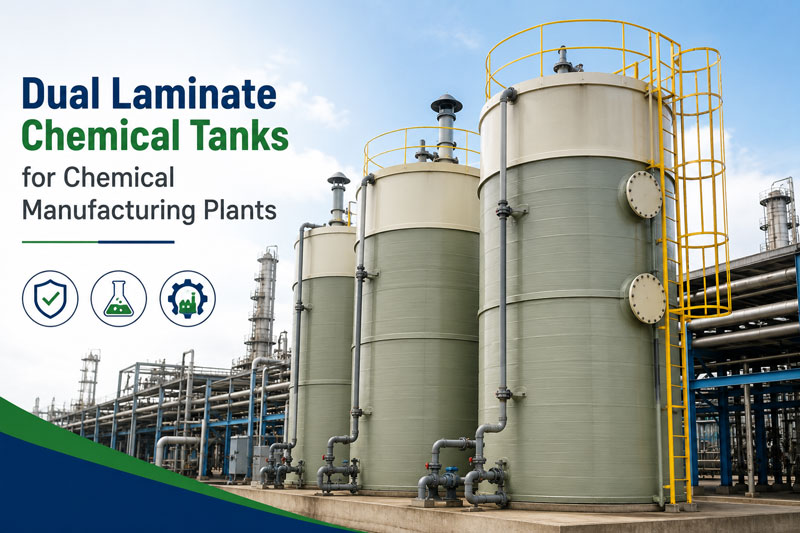
Chemical manufacturing plants operate in some of the most demanding industrial environments, where storage tanks are continuously exposed to highly corrosive chemicals, aggressive acids, alkalis, solvents, and elevated process temperatures. Selecting the right chemical storage solution is critical to ensuring operational safety, minimizing maintenance costs, and extending equipment life.
Among the various storage solutions available today, Dual Laminate Chemical Tanks have become one of the most preferred options for chemical manufacturing plants because they combine the excellent chemical resistance of thermoplastics with the structural strength of composite materials.
At Nivra Envirotech Pvt. Ltd., we manufacture high-performance Dual Laminate Chemical Tanks designed for chemical processing, pharmaceutical, petrochemical, water treatment, fertilizer, textile, and other industrial applications requiring superior corrosion resistance.
What Are Dual Laminate Chemical Tanks?
Dual Laminate Chemical Tanks are advanced industrial storage tanks manufactured using two different layers:
- Internal Thermoplastic Liner
- External Composite (FRP) Reinforcement
The thermoplastic inner layer provides outstanding resistance against corrosive chemicals, while the outer FRP structure offers mechanical strength and long-term structural stability.
This combination makes dual laminate tanks ideal for industries where conventional FRP or steel tanks may not provide sufficient chemical resistance.
Material of Construction (MOC)
At Nivra Envirotech, dual laminate tanks are manufactured using premium-quality thermoplastics and composite materials based on the chemical application.
Thermoplastic Materials
Our tanks can be manufactured using:
- PP (Polypropylene)
- PPH (Polypropylene Homopolymer)
- HDPE (High Density Polyethylene)
- C-PVC (Chlorinated Polyvinyl Chloride)
- PVDF (Polyvinylidene Fluoride)
- TFM
- FEP
- PFA
- ECTFE
Each thermoplastic offers specific advantages depending on the chemical composition, temperature, and operating conditions.
Composite Materials
The external structural layer can be manufactured using:
- FRP (Fiberglass Reinforced Plastic)
- FRB
- FRVE
- FRVS
These materials provide excellent structural integrity while protecting the thermoplastic liner.
Why Chemical Manufacturing Plants Prefer Dual Laminate Chemical Tanks
Chemical manufacturing facilities handle highly corrosive substances that demand exceptional chemical compatibility and long-term durability.
Dual laminate tanks offer several advantages:
- Outstanding corrosion resistance
- Excellent chemical compatibility
- High structural strength
- Longer service life
- Low maintenance requirements
- Leak-proof construction
- Lightweight design
- UV and weather resistance
- Lower lifecycle costs
- Custom-designed fabrication
These features make them one of the most reliable storage solutions for chemical industries.
Common Chemicals Stored in Dual Laminate Tanks
Dual laminate chemical tanks are suitable for storing a wide variety of aggressive chemicals, including:
- Sulfuric Acid
- Hydrochloric Acid
- Nitric Acid
- Phosphoric Acid
- Hydrofluoric Acid
- Acetic Acid
- Caustic Soda
- Sodium Hypochlorite
- Ferric Chloride
- Solvents
- Industrial Alkalis
- Process Chemicals
Material selection depends on chemical concentration, operating temperature, and process conditions.
Applications in Chemical Manufacturing Plants
Dual laminate tanks are widely used for:
- Raw Chemical Storage
- Acid Storage
- Alkali Storage
- Process Chemical Storage
- Chemical Mixing
- Intermediate Chemical Storage
- Bulk Chemical Storage
- Chemical Transfer Systems
- Dosing Applications
- Waste Chemical Collection
They are suitable for both indoor and outdoor industrial installations.
Industries Using Dual Laminate Chemical Tanks
In addition to chemical manufacturing plants, these tanks are extensively used in:
- Pharmaceutical Industries
- Petrochemical Plants
- Water Treatment Plants
- Wastewater Treatment Facilities
- Fertilizer Manufacturing
- Textile Processing
- Electroplating Industries
- Food Processing Plants
- Mining Industries
- Semiconductor Manufacturing
Dual Laminate vs Conventional Storage Tanks
| Feature | Dual Laminate Tanks | Steel Tanks | Standard FRP Tanks |
|---|---|---|---|
| Corrosion Resistance | Excellent | Moderate | High |
| Chemical Compatibility | Excellent | Limited | Good |
| Structural Strength | Excellent | Excellent | High |
| Maintenance | Very Low | High | Low |
| Service Life | Long | Moderate | Long |
| Suitable for Strong Acids | Yes | Limited | Depends on Chemical |
How to Choose the Right Dual Laminate Chemical Tank
Selecting the right storage tank depends on several factors.
1. Chemical Compatibility
The thermoplastic liner should be compatible with the chemical being stored.
2. Operating Temperature
Higher temperatures may require premium materials such as PVDF, PFA, or ECTFE.
3. Tank Capacity
Capacity should be selected according to storage requirements and future expansion plans.
4. Installation Location
Indoor and outdoor installations require different design considerations.
5. Engineering Standards
Always choose a manufacturer capable of designing tanks according to international industrial standards.
Why Choose Nivra Envirotech?
Nivra Envirotech is a trusted Dual Laminate Chemical Tanks Manufacturer specializing in corrosion-resistant storage solutions for demanding industrial applications.
We offer:
- Custom Dual Laminate Chemical Tanks
- Vertical & Horizontal Storage Tanks
- Acid Storage Tanks
- Chemical Process Tanks
- Thermoplastic Chemical Storage Tanks
- FRP Tanks & Vessels
- Industrial Process Equipment
- Engineering & Design Support
- Installation & Commissioning
- Technical Consultation
Every tank is manufactured using high-quality materials and tested to ensure reliable performance under challenging operating conditions.
Frequently Asked Questions
What is a Dual Laminate Chemical Tank?
A dual laminate chemical tank consists of an internal thermoplastic liner combined with an external FRP composite structure, providing both chemical resistance and structural strength.
Why are Dual Laminate Tanks used in chemical manufacturing plants?
They offer superior resistance to corrosive chemicals while maintaining excellent mechanical strength and a long operational life.
Which materials are used in Dual Laminate Tanks?
Thermoplastic materials such as PP, PPH, HDPE, C-PVC, PVDF, TFM, FEP, PFA, and ECTFE are combined with composite materials including FRP, FRB, FRVE, and FRVS.
Can Dual Laminate Tanks store strong acids?
Yes. When designed with the appropriate thermoplastic liner, dual laminate tanks are suitable for storing sulfuric acid, hydrochloric acid, nitric acid, phosphoric acid, caustic soda, and many other aggressive chemicals.
Can the tanks be customized?
Yes. Tank size, capacity, material, nozzle configuration, fittings, supports, and accessories can all be customized to suit specific industrial requirements.
Conclusion
For chemical manufacturing plants, selecting the right storage solution is essential for ensuring safe operations, reducing maintenance, and maximizing equipment life. Dual Laminate Chemical Tanks provide the ideal combination of exceptional chemical resistance, structural strength, and long-term durability, making them the preferred choice for storing aggressive chemicals in demanding industrial environments.
Whether you require tanks for acid storage, alkali storage, chemical processing, or bulk chemical handling, Nivra Envirotech Pvt. Ltd. manufactures customized dual laminate chemical tanks engineered to deliver reliable performance and meet international quality standards.
Request a Quote Today
Looking for a reliable Dual Laminate Chemical Tanks Manufacturer for your chemical manufacturing plant? Contact Nivra Envirotech today to discuss your project requirements, request a customized tank design, or receive a competitive quotation from our engineering experts.
- acid storage tanks
- Chemical Manufacturing Plants
- Chemical Process Tanks
- chemical storage tanks
- Composite Chemical Tanks
- Corrosion Resistant Chemical Tanks
- Dual Laminate Chemical Tanks
- Dual Laminate Chemical Tanks Manufacturer
- Dual Laminate Storage Tanks
- Dual Laminate Tank Manufacturer India
- FRP chemical tanks
- HDPE Chemical Tanks
- industrial chemical storage tanks
- industrial storage tanks
- Nivra Envirotech
- PP Chemical Tanks
- PPH Storage Tanks
- PVDF Chemical Tanks
- Thermoplastic Chemical Storage Tanks