
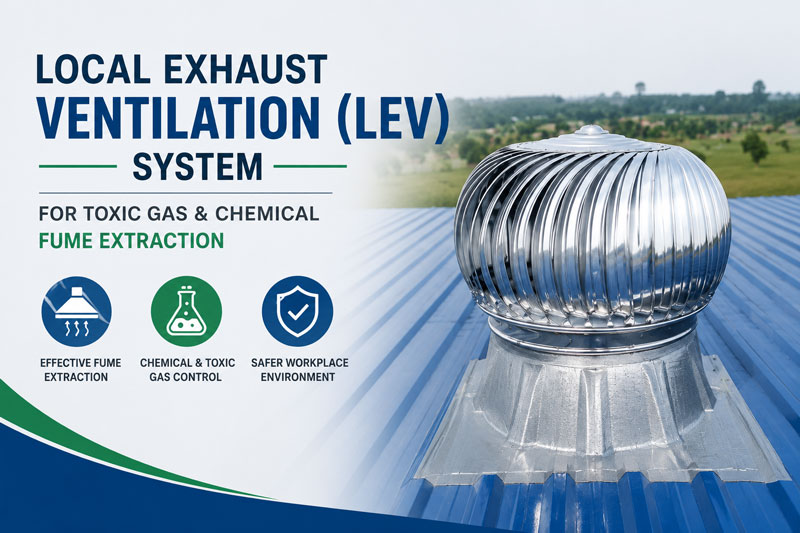
Industrial processes involving chemicals, acids, solvents, powders, fumes, and hazardous gases can release contaminants into the workplace atmosphere. If these pollutants are not captured at their source, they can spread throughout the facility, affecting indoor air quality, worker safety, equipment, and overall plant efficiency.
A Local Exhaust Ventilation System for Toxic Gas & Chemical Fume Extraction provides an effective solution by capturing contaminated air directly at the point where it is generated and transporting it to an appropriate treatment system.
Unlike general ventilation, which attempts to dilute contaminated air throughout a workplace, Local Exhaust Ventilation (LEV) focuses on source capture. This makes LEV systems particularly valuable for chemical manufacturing, pharmaceutical, electroplating, textile processing, metal finishing, laboratories, and other industries handling hazardous substances.
Nivra Envirotech Pvt. Ltd. designs and manufactures customized Local Exhaust Ventilation Systems for industrial fume extraction and can integrate LEV systems with corrosion-resistant ducting, industrial blowers, FRP wet scrubbers, packed bed scrubbers, and other air pollution control equipment.
What Is a Local Exhaust Ventilation System?
A Local Exhaust Ventilation (LEV) System is an engineered ventilation system designed to capture harmful contaminants at or near their source before they enter the general workplace environment.
An industrial LEV system typically consists of:
- Extraction hoods
- Capture points
- FRP, PP, PVC, or HDPE ducting
- Industrial exhaust blowers
- Dampers and valves
- Scrubbing or filtration equipment
- Exhaust stacks or chimneys
- Supporting structures and accessories
The exact configuration depends on the type of contaminant, airflow requirement, chemical characteristics, temperature, process conditions, and plant layout.
Why Is LEV Important for Toxic Gas and Chemical Fume Extraction?
Chemical processes can generate contaminants such as acid fumes, alkaline vapours, toxic gases, solvent vapours, and process emissions. Allowing these pollutants to escape into the workplace can create unnecessary exposure risks.
A properly engineered Local Exhaust Ventilation System helps capture these emissions before they disperse.
Key benefits include:
- Captures contaminants at the source
- Reduces worker exposure to hazardous fumes
- Improves workplace air quality
- Reduces the spread of chemical vapours
- Supports industrial hygiene requirements
- Helps protect equipment from corrosive fumes
- Improves the efficiency of downstream treatment equipment
- Supports cleaner and safer industrial operations
What Toxic Gases and Chemical Fumes Can an LEV System Handle?
The contaminants handled by an LEV system depend on the industrial process and the associated treatment equipment.
Typical applications include extraction of:
- Acid fumes
- Alkaline vapours
- Chlorine-containing gases
- Ammonia fumes
- Sulphur-containing gases
- Solvent vapours
- Chemical vapours
- Toxic process gases
- Welding fumes
- Dust and particulate emissions
- Oil mist
- Process odours
The LEV system itself primarily captures and transports contaminated air. Where hazardous gases need to be removed or neutralized, the extracted air can be directed to a suitable scrubber, filter, or other air pollution control equipment.
How Does a Local Exhaust Ventilation System Work?
A typical industrial LEV system follows a straightforward process.
Step 1: Identify the Contaminant Source
The first step is identifying where toxic gases, fumes, vapours, dust, or other contaminants are generated.
Examples include chemical reactors, mixing tanks, electroplating baths, filling stations, storage areas, production machines, and processing lines.
Step 2: Capture the Contaminant
A suitably designed hood or extraction point is installed close to the emission source.
The objective is to capture the contaminant before it spreads into the surrounding workplace.
Step 3: Transport Contaminated Air
The captured air travels through corrosion-resistant industrial ducting.
Depending on the application, materials such as FRP, PP, PVC, or HDPE may be selected.
Step 4: Treat the Extracted Air
If the extracted air contains hazardous gases or chemical fumes, it can be directed to treatment equipment such as an FRP Wet Scrubber, packed bed scrubber, or other appropriate air pollution control system.
Step 5: Discharge Treated Air
After suitable treatment, the exhaust stream is discharged through an engineered stack or chimney according to the applicable project and environmental requirements.
LEV System with FRP Wet Scrubber
For chemical industries, combining Local Exhaust Ventilation with an FRP Wet Scrubber System can provide a complete source-capture and gas-treatment solution.
The process can be represented as:
Contaminant Source → LEV Hood → FRP/PP Ducting → Industrial Blower → FRP Wet Scrubber → Exhaust Stack
The LEV system captures the contaminated air, while the wet scrubber treats the pollutants contained in the exhaust stream.
This integrated approach is particularly useful where corrosive or water-soluble gases need to be removed from industrial exhaust.
Applications of Local Exhaust Ventilation Systems
Local Exhaust Ventilation is used across a wide range of industrial applications.
Chemical Manufacturing
Chemical reactions, mixing, filling, and transfer operations can generate corrosive fumes and hazardous vapours. LEV systems capture these emissions at their source.
Pharmaceutical Manufacturing
Pharmaceutical production may involve powders, solvents, active ingredients, and chemical vapours requiring controlled extraction.
Electroplating
Electroplating tanks can release acid mist, alkaline vapours, and chemical fumes. Proper extraction helps prevent these contaminants from entering the workplace atmosphere.
Textile Processing
Dyeing, chemical treatment, coating, and finishing operations can generate process fumes and vapours requiring localized extraction.
Metal Finishing
Pickling, cleaning, surface treatment, and plating processes can generate corrosive fumes and gases.
Battery Manufacturing
Battery production and related chemical processes can generate hazardous fumes that require appropriately designed extraction and treatment systems.
Laboratories
Laboratories handling chemicals, solvents, and reactive substances can benefit from localized extraction systems designed around specific emission sources.
Materials Used for LEV Ducting
Material selection is an important consideration when designing an industrial fume extraction system.
Depending on the application, ducting may be manufactured using:
- FRP
- PP
- PVC
- HDPE
For highly corrosive chemical environments, corrosion-resistant materials can significantly improve system durability and reduce maintenance requirements.
The correct material should be selected based on chemical compatibility, temperature, concentration, airflow, and operating conditions.
Key Factors When Designing an LEV System
A successful Local Exhaust Ventilation System for Toxic Gas & Chemical Fume Extraction requires proper engineering rather than simply installing an exhaust fan.
Important design considerations include:
Contaminant Characteristics
Understand the type, concentration, temperature, toxicity, and chemical properties of the contaminant.
Capture Point
The extraction hood should be positioned appropriately to capture pollutants before they enter the breathing zone.
Airflow Requirements
The system must provide sufficient airflow to effectively capture and transport contaminants.
Duct Design
Duct diameter, routing, bends, branches, velocity, and pressure losses should be considered during system design.
Blower Selection
The blower should be selected according to the required airflow, static pressure, temperature, and chemical environment.
Treatment Equipment
If toxic or corrosive gases are present, the LEV system may need to be integrated with a scrubber or other suitable treatment technology.
Material Compatibility
All components exposed to aggressive chemicals should be manufactured from materials compatible with the process environment.
Benefits of a Customized Industrial LEV System
Every industrial facility has a different process layout and emission profile. A customized LEV system can provide:
- Better source capture
- Improved airflow management
- Reduced pollutant dispersion
- Greater equipment reliability
- Better integration with scrubbers
- Reduced maintenance
- Efficient use of plant space
- Scalable design for future requirements
For this reason, businesses should work with an experienced Local Exhaust Ventilation System Manufacturer rather than selecting a standard exhaust arrangement without evaluating the process.
Why Choose Nivra Envirotech?
Nivra Envirotech provides customized industrial environmental and process equipment solutions for applications involving chemical handling, pollution control, and industrial exhaust management.
Our solutions can include:
- Local Exhaust Ventilation Systems
- Industrial Fume Extraction Systems
- FRP and Thermoplastic Ducting
- Industrial Exhaust Blowers
- FRP Wet Scrubbers
- Packed Bed Scrubbers
- Chemical Gas Scrubbers
- Toxic Gas Removal Systems
- Industrial Air Pollution Control Systems
- Customized Exhaust Treatment Solutions
By integrating source capture, ducting, air movement, and pollutant treatment, industries can develop a more complete approach to workplace air quality and emission control.
Frequently Asked Questions
What is a Local Exhaust Ventilation System?
A Local Exhaust Ventilation System captures fumes, gases, vapours, dust, and other airborne contaminants directly at their source before they spread throughout the workplace.
Can LEV systems remove toxic gases?
LEV systems primarily capture and transport contaminated air. When toxic gases require removal or neutralization, the extracted air can be connected to appropriate treatment equipment such as wet scrubbers or packed bed scrubbers.
What industries use Local Exhaust Ventilation?
Chemical, pharmaceutical, electroplating, textile, metal finishing, battery manufacturing, laboratories, food processing, and other industries can use LEV systems depending on their processes and emission sources.
Can an LEV system be connected to an FRP scrubber?
Yes. LEV systems can be integrated with FRP wet scrubbers or packed bed scrubbers to capture contaminated air at the source and subsequently treat the extracted gases.
Which materials are suitable for LEV ducting?
FRP, PP, PVC, and HDPE are commonly considered for industrial ducting, with material selection depending on chemical compatibility, temperature, concentration, and operating conditions.
How do I choose the right Local Exhaust Ventilation System?
The system should be selected based on contaminant type, emission source, required capture airflow, plant layout, ducting requirements, blower capacity, chemical compatibility, and the need for downstream treatment.
Conclusion
A properly engineered Local Exhaust Ventilation System for Toxic Gas & Chemical Fume Extraction can play an important role in maintaining cleaner and safer industrial workplaces. By capturing pollutants at their source and transporting them through appropriately designed ducting to suitable treatment equipment, industries can reduce the spread of hazardous contaminants and improve overall exhaust management.
For chemical and process industries, integrating Local Exhaust Ventilation, corrosion-resistant ducting, industrial blowers, and FRP wet scrubbers can provide a comprehensive approach to industrial fume extraction and air pollution control.
Nivra Envirotech offers customized solutions for industrial exhaust and pollution control applications, helping businesses select and integrate the right equipment according to their process requirements.
Request a Customized Solution
Looking for a Local Exhaust Ventilation System Manufacturer for toxic gas, chemical fume, or industrial exhaust extraction? Contact Nivra Envirotech to discuss your application and requirements and explore a customized industrial fume extraction solution.
- Acid Fume Extraction
- Air Pollution Control System
- Chemical Fume Extraction
- chemical fume extraction system
- FRP Ducting
- FRP Wet Scrubber
- Industrial Exhaust Blower
- industrial exhaust treatment
- Industrial Fume Extraction Manufacturer
- Industrial Fume Extraction System
- Industrial Ventilation System
- LEV System
- Local Exhaust Ventilation
- Local Exhaust Ventilation Manufacturer
- Local Exhaust Ventilation System
- packed bed scrubber
- Toxic Gas Extraction
- toxic gas removal system