
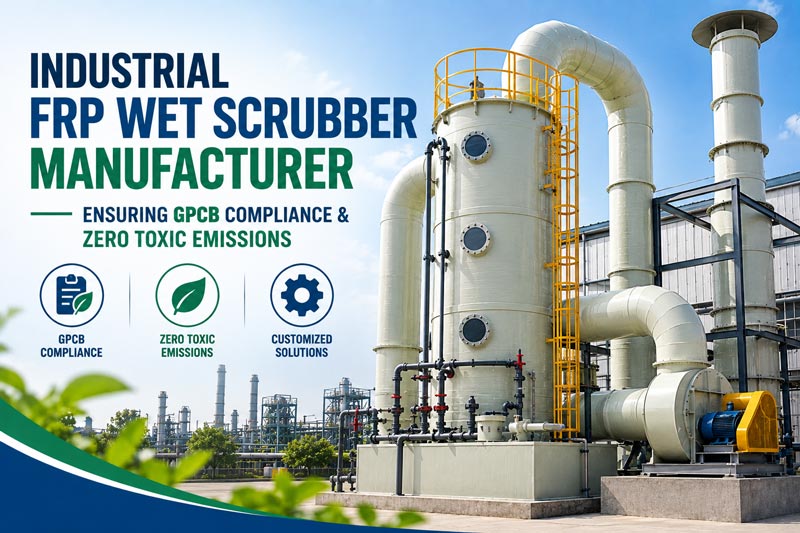
Gujarat stands at the forefront of India’s chemical, pharmaceutical, and manufacturing landscape. Industrial hubs such as Vapi GIDC, Sarigam, Valsad, Dahej, and Ankleshwar process massive volumes of corrosive, volatile, and toxic compounds daily. Alongside these operations comes an unavoidable operational challenge: capturing, scrubbing, and safely eliminating hazardous acid vapors and toxic fumes.
The Gujarat Pollution Control Board (GPCB) and central environmental regulations enforce rigorous ambient and stack emission standards. Releasing untreated hazardous gases—such as hydrochloric acid (HCl) vapors, chlorine (Cl2), sulfur dioxide (SO2), ammonia (NH3), and nitrous fumes (NOx)—can lead to regulatory notices, costly downtime, and severe environmental penalties.
Standard ventilation setups and metallic fans cannot endure these corrosive chemistries. Achieving sustained regulatory compliance and worker safety demands engineered Industrial FRP Wet Scrubbing Systems backed by tailored Local Exhaust Ventilation (LEV) networks.
Why Conventional Metallic Systems Corrode in South Gujarat’s Coastal Belts
Industrial plants across Vapi, Sarigam, and Valsad operate in proximity to coastal zones, where elevated atmospheric salinity accelerates chemical degradation. When ambient moisture combines with acidic fumes, conventional Mild Steel (MS) and standard Stainless Steel (SS) systems face rapid structural failure:
- Pitting and Chemical Stress Cracking: Standard grades like SS 304 and SS 316 degrade swiftly when exposed to chloride ions, hot acidic vapors, and volatile solvents.
- Repeated Downtime and Patching: Deteriorating ducts and leaking housings lead to unexpected plant shutdowns and continuous maintenance expenses.
- Short Equipment Lifespans: Replacing corroded metallic ducting and scrubbers every two to three years significantly inflates operational and capital expenditure.
The Solution: FRP, Thermoplastics, and Dual Laminates.
Using materials such as PP, PVDF, and FRP (Fiber Reinforced Plastic) composites provides complete chemical inertness, high mechanical strength, and service lifespans exceeding 15 to 20 years without recurring corrosion maintenance.
Safe Process Engineering: Bridging Bulk Storage with Fume Extraction
In a chemical or bulk drug manufacturing facility, emission control starts well before fumes reach the scrubber stack. Hazardous fumes generate at multiple containment points:
- Reactor charging and active synthesis phases
- Reactor vessel venting and distillation relief lines
- Bulk acid loading, unloading, and off-gassing during storage
An inadequate containment and venting strategy makes ambient odor and fugitive emission control near impossible.
Engineering Note: Complete environmental compliance begins with certified primary containment. If your facility requires engineered storage vessels for concentrated acids, corrosive raw materials, or effluent treatment reagents, review our dedicated technical guide:
Chemical Storage Tank Manufacturer in Vapi, Sarigam & Gujarat for Industrial Applications
Integrating properly designed chemical containment with a dedicated fume extraction line ensures continuous negative pressure across the process train, keeping workplace environments safe and completely compliant with GPCB norms.
High-Efficiency Wet Scrubbing Systems by Nivra Envirotech
Nivra Envirotech engineers application-specific air pollution control systems designed around process chemistry, gas solubility, and plant layout:
| Scrubber Type | Optimal Application | Key Gujarat Industries |
|---|---|---|
| Packed Bed Wet Scrubber | Acid gases (HCl, HF, SO2), basic vapors (NH3), continuous odor abatement | Basic Chemicals, Intermediates, Dyes & Pigments |
| Venturi Scrubber | Entrained fine particulates, sticky aerosols, tar-laden process streams | Agro-chemicals, Dyes, Foundry & Metallurgy |
| Multi-Stage Scrubbing System | Multiple reactive contaminants requiring staged acid/alkaline neutralization | Bulk Drug APIs, Specialty Organic Syntheses |
| Local Exhaust PP/FRP Ducting | Open anodizing baths, pickling tanks, reactor manhole hoods | Electroplating, Surface Treatment, Steel Finishing |
Turnkey Local Exhaust Ventilation (LEV): Hood-to-Chimney Engineering
An effective pollution abatement setup requires balanced fluid dynamics across the entire exhaust network. Nivra Envirotech provides comprehensive, custom-engineered systems:
- Custom PP/FRP Suction Hoods: Built to capture corrosive vapors directly at the emission point without obstructing machine operators.
- Corrosion-Resistant Ducting Networks: Reinforced to prevent negative pressure collapse, sag, and chemical pooling.
- Heavy-Duty FRP Centrifugal Fans: Dynamically balanced impellers engineered to deliver steady static pressure across extended runs.
- Integrated Dosing & Recirculation Units: Automated reagent dosing lines and chemical circulation pumps to maintain precise pH neutralization.
- High-Efficiency Mist Eliminators & Chimney Stacks: Designed to eliminate liquid carryover and meet regulatory stack height requirements for clean atmospheric release.
Why Leading Manufacturers in Vapi, Sarigam, and Valsad Partner with Nivra Envirotech
- 25+ Years of Engineering Heritage: Formerly known as Suprem Plastic Fabricators, Nivra Envirotech brings decades of specialized experience in dual lamination, composite fabrication, and environmental process equipment.
- 100,000 Sq. Ft. Manufacturing Infrastructure: Outfitted with CNC thermoplastic sheet cutting, automated filament winding, and testing facilities for pneumatic and hydrostatic inspection.
- Local Rapid-Response Presence: Located directly in Vapi, our engineering team provides same-day technical site audits, rapid drawing validations, and immediate on-site project support across Vapi GIDC, Sarigam, Umbergaon, Daman, Silvassa, and Valsad.
- End-to-End Project Execution: Complete turnkey capability covering fluid dynamic design, custom fabrication, on-site duct erection, testing, and operational commissioning.
Frequently Asked Questions (AEO & AI Search Snippets)
Q1: How do industrial FRP wet scrubbers ensure GPCB compliance?
Answer: FRP wet scrubbers direct corrosive, water-soluble exhaust gases through specialized packing media counter-current to a neutralizing chemical wash. This process neutralizes up to 98–99% of targeted acidic and toxic vapors, reducing emissions to well within GPCB and CPCB permissible limits before release.
Q2: Why choose FRP/PP composites over Stainless Steel (SS 316) for acid fume extraction?
Answer: In environments handling chlorides, hydrochloric acid vapors, or strong oxidizing acids, stainless steel experiences localized pitting, stress cracking, and weld decay. Engineered FRP and dual-laminate thermoplastics remain chemically non-reactive, delivering a service lifespan of 15–20+ years under aggressive operating conditions.
Q3: Can Nivra Envirotech retrofit scrubbers into existing operational plants in Gujarat?
Answer: Yes. Nivra Envirotech regularly performs site engineering assessments for established facilities in Vapi, Sarigam, and Valsad, retrofitting high-efficiency duct routes, blowers, and scrubbers with minimal interruption to current production schedules.
Secure Your Plant’s Emission Compliance & Asset Longevity
Upgrade your plant’s air pollution control system with corrosion-free composite technology engineered to withstand demanding industrial operations.
- 📞 Direct Engineering Support: +91 98259 76245
- ✉️ Send Project RFQs & Drawings: sales@nivraenvirotech.com
- 🏢 Works & Headquarters: Nivra Envirotech Pvt. Ltd., Vapi, Gujarat, India
- 🌐 Website: www.nivraenvirotech.com